.png)
 2 hours ago
1
2 hours ago
1
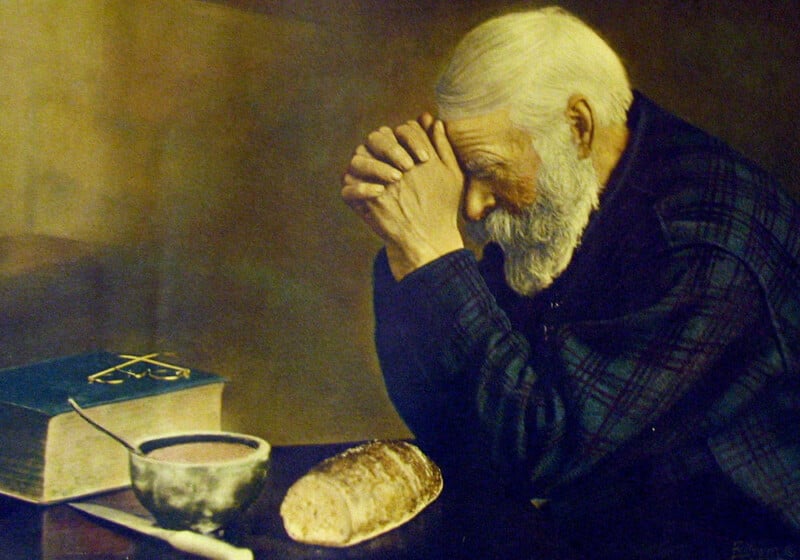 It’s this version of Grace, enhanced by oil painting, that found its way into churches, restaurants, and homes across the U.S. and beyond. | Eric Enstrom
When Eric Enstrom entered his photograph of Charles Wilden sitting at a table with his head bowed into a Minnesota photo contest, it lost because the judges thought it didn’t make enough use of light.
Undeterred, Enstrom added a window to the image by scratching the negative with a small metal tool. He also managed to make it look like light was falling on Wilden, presumably via some creative dodging and burning in the darkroom.
Grace, as the photograph came to be known, was taken in 1918 (although some believe it was taken in 1920), and it became such a hit that Minnesota adopted it as its official state photograph — the only state to have an official photo.
 The original version of Grace, before Enstrom added a ‘window’ to it and before it was made more painterly.
Lilah Crow of the Itasca County Historical Society tells CBS News that Enstrom, a Swedish immigrant, took 10 photos of Wilden, also a Swedish immigrant, in a prayer pose in his apartment in Bovey, which is in Itasca County.
“A lot of people come in here and they go, ‘That looks just like my grandpa,'” says Crowe.
It is in Bovey where Grace is most cherished; CBS News notes that visitors to Bovey will find versions of Grace on benches, bicycle racks, and a mural of it on the side of Enstrom’s old photo studio.
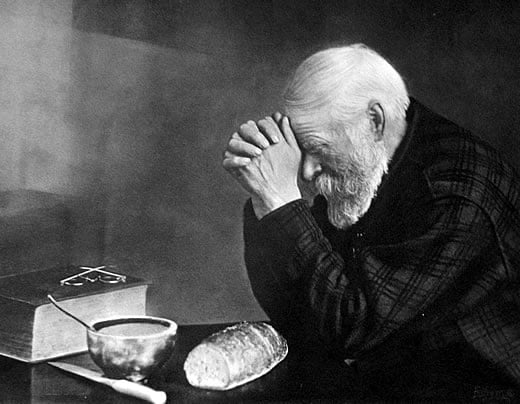 Enstrom scratched in a window using a metal tool, and played with all the elements in the photo.
Despite the initial disappointment of the competition rejection, Enstrom continued to iterate on his photo: changing the colors in the portrait and altering Wilden’s beard.
The photographer’s daughter, Rhoda Nyberg, began hand-coloring the black-and-white photograph with oil paints in the 1940s — it’s this version that became popular and widely reproduced.
While Minnesotans adore the photo, it can be found in homes across the world. Critics believe it’s because it shows an image of quiet piety (the book on the table is actually a dictionary but Enstrom later declared it to be a Bible; perhaps that is what he had always intended to represent).
In 2000, a bill sponsored by the Governor of Minnesota, Jesse Ventura, for Grace to become the state photograph passed unanimously. That law means the photograph must hang in the Secretary of State’s office in St. Paul.
 The mural in Bovey on the side of Enstrom’s old studio | Lorie Shaull
Little is known about the subject, Wilden. Wikipedia says he scraped a living as a peddler and lived in a sod house, which is a little like a Hobbit-hole. He was paid $5 by Enstrom to secure all rights to the photograph in 1926. Despite attempts by historians to find out what happened to Enstrom afterward, nothing conclusive has ever been discovered.
Enstrom himself was no one-hit wonder; he took the first professional photographs of Judy Garland.








 English (US) ·