.png)
DC Comics
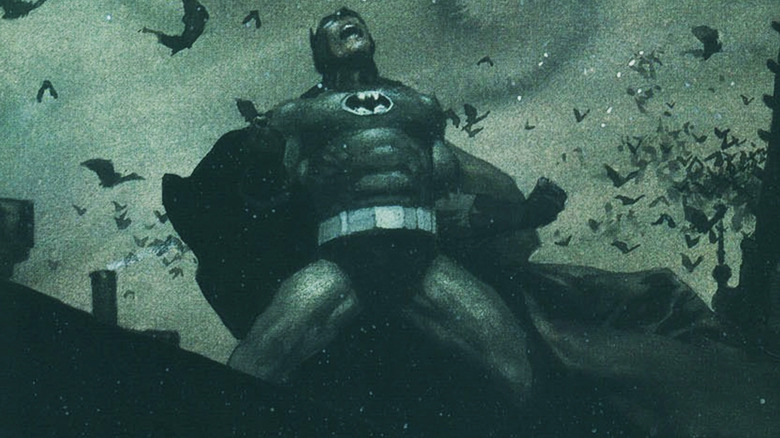
There have been plenty of grim moments in the Dark Knight's almost 90-year history, but 1992's "Batman: Night Cries" might be the darkest. Unlike "Batman: Dark Knight, Dark City," which went dark via a wild horror twist, this moody, unsettling, yet hauntingly beautiful one-shot sees Gotham's protector investigating a drug running operation which he links to a series of murders involving child abuse. Aside from being one of the most disturbing Gotham City stories ever told, it's also one of the best.
Batman stories run the gamut from outlandish and fantastical to grounded and gritty. The 1950s and 60s were particularly light-hearted, giving us some of the most bizarre Silver Age villains in Batman history at a time when the Caped Crusader's adventures were all about capitalizing on the popularity of sci-fi. While Julius Schwartz managed to overhaul things with the "new-look" Batman in 1964, it wasn't until the '70s and '80s that the character truly became the "weird figure of the dark" envisioned by creators Bob Kane and Bill Finger back in 1939. As gloomy and thematically rich as "Batman: Year One" or "The Dark Knight Returns" were, however, neither felt as chillingly realistic and hauntingly evocative as "Batman: Night Cries."
Written by Archie Goodwin and illustrated by Scott Hampton, "Night Cries" not only grappled with perhaps the darkest subject of them all — child abuse — but also managed to explore both Batman and James Gordon's own characters in a compelling way, making for an unforgettable Batman story that has, unfortunately, gone overlooked by in the larger discussion of classic Batman tales.
Batman: Night Cries is an overlooked gem of a story
DC Comics
Had "Batman: Night Cries" been released more recently, it would easily be one of the best DC Black Label comics. More than that, "Night Cries" deserves to be included in discussions of the best Batman comics ever written but has thus far failed to garner the same widespread recognition as other classic tales. To those who have read it, however, it remains unforgettable.
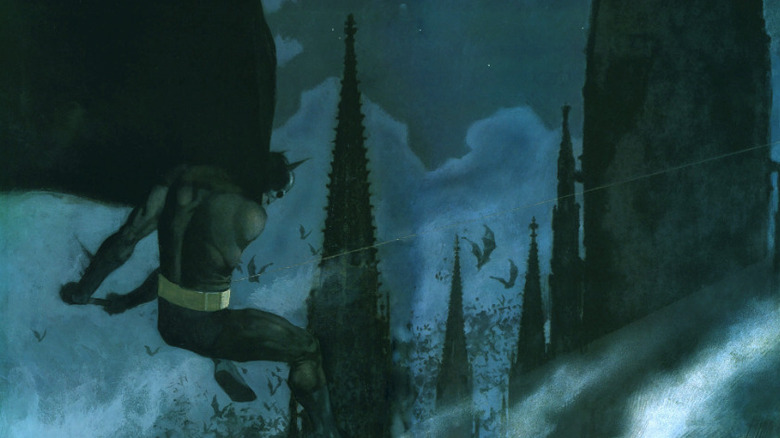
The most immediately striking thing about the comic is the art style. Dave McKean's illustrations in "Arkham Asylum in A Serious House on Serious Earth" are rightly remembered for representing some of the most arresting, evocative art in the history of Batman comics. But for whatever reason, you don't hear as much about Scott Hampton's contributions to "Batman: Night Cries," which were every bit as immersive and haunting. The art style of this oft-overlooked one-shot is not only beautifully atmospheric, but like McKean's work on "Arkham Asylum" it plays into the murky themes of the story, enhancing the narrative through the visuals to form an unforgettable whole.
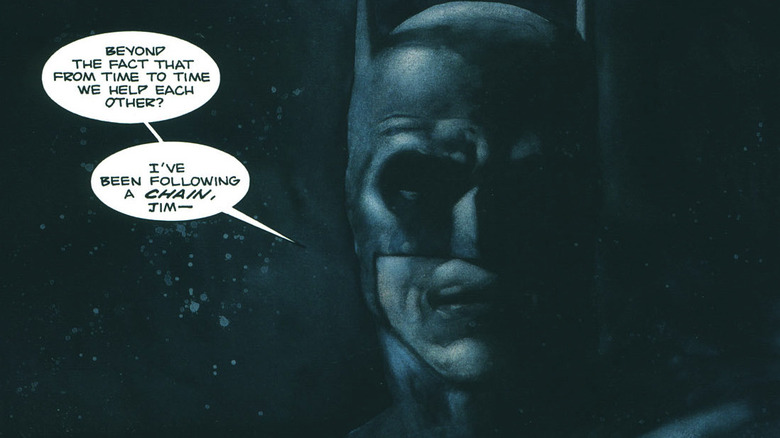
That narrative is about as far from the fanciful exploits of the Silver Age caped crusader as you could possibly get, but that's what makes "Night Cries" so brilliant. The story is as much about Commissioner James Gordon as it is Batman, with Archie Goodwin using what are essentially two protagonists to explore the issues raised by the criminal investigation. Examining the psyches of two leads alongside the main plot might have made for a disjointed or overly busy story, but it's remarkably cohesive, using the themes thrown up by the central narrative to gain an insight into Gordon and Bruce. That approach leads to some of the most indelible moments in Batman history.
Batman: Night Cries deserves to be recognized as a classic
DC Comics
In "Batman: Night Cries" James Gordon investigates the killing of two families while Batman investigates the arrival of a new drug in Gotham that "produces a faster, more violent high than crack." The Dark Knight quickly establishes a link between the drugs and the killings and soon a horrific reality comes to the fore. The victims have all been involved in child abuse, and the killer is seemingly attempting to avenge the children at the heart of this story.
Addressing such a harrowing topic in a comic book could have been seen as inappropriate or perhaps even disrespectful. But it's a testament to how Archie Goodwin and Scott Hampton grounded their story in a world that feels real and, more importantly serious, that "Night Cries" never once treats its grave subject matter frivolously. Goodwin writes the often deeply upsetting scenes with a quiet respect for the gravity of the topic while Hampton's expressive painted art — which straddles the line between impressionistic and naturalistic — adds to the overall sense of maturity on display here.
This leads to several standout moments, including a strikingly touching scene in which Batman unmasks to put an abused girl at ease. Bruce's empathy for the victims reaffirms his own humanity and infuses the story with a tenderness that you might not expect from what is otherwise one of the darkest of the Dark Knight's tales. You can see echoes of "Night Cries" in 2022's "The Batman," in which Robert Pattinson's vigilante sees himself in the bereaved child of Gotham's mayor. But the comic arguably explores that idea more deeply and effectively, which is just one reason why it deserves to be in the conversation around the best Batman stories ever told.






 English (US) ·