.png)
 5 days ago
14
5 days ago
14
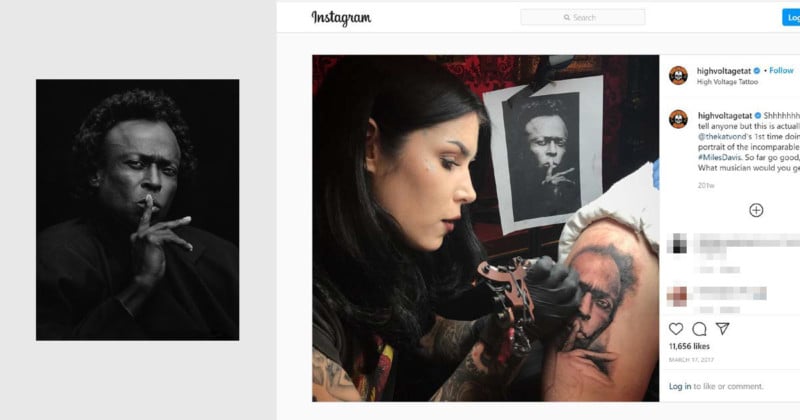
An appeals court upheld a verdict clearing celebrity tattoo artist Kat Von D of copyright infringement over her use of a photographer’s image of Miles Davis. However, two judges used the ruling to question whether the long-standing legal test for determining when one creative work copies another remains valid.
In July, photographer Jeffrey Sedlik asked the US Court of Appeals for the Ninth Circuit to erase the 2024 jury verdict that Von D’s tattoo — partly traced from his photo of the jazz legend — wasn’t similar enough to be considered copyright infringement.
In 2021, Sedlik filed a first-of-its-kind lawsuit accusing Von D of infringing on his copyright by using his iconic 1989 photo of Davis for a tattoo on her friend Blake Farmer — that she inked free-of-charge for him.
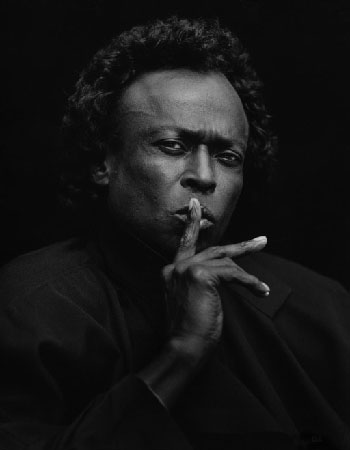 The iconic photo of Miles Davis by Jeff Sedlik that’s at the center of this legal battle. Image from court filing exhibit.
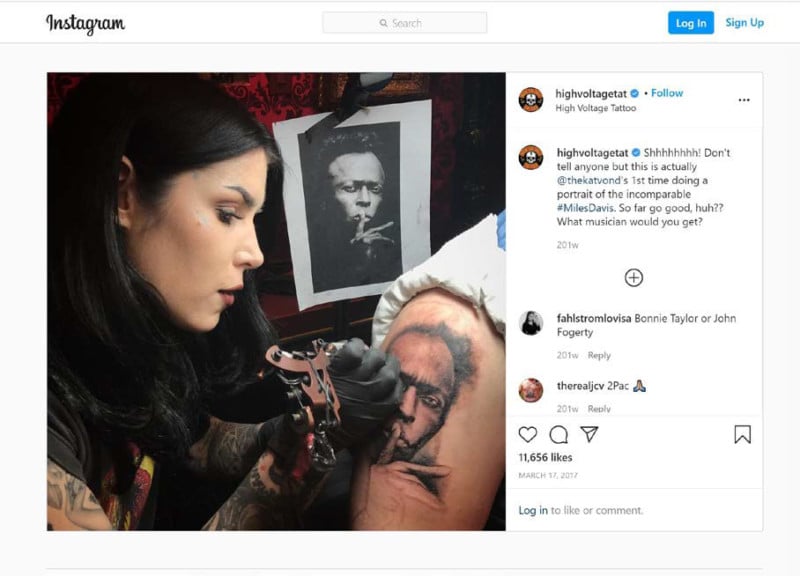 Screenshot from court filing exhibit.
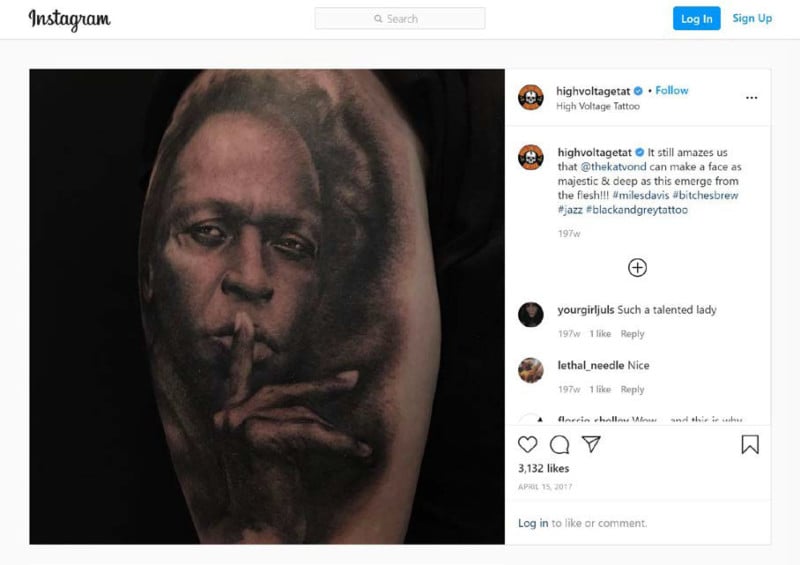 Screenshot from court filing exhibit.
On January 2, the Ninth Circuit declined to overturn the jury’s decision, writing that doing so would require the judges to replace the jurors’ judgment with their own, something the court says it “cannot do.” As a result, the verdict in Von D’s favor remains in place.
However, the ruling went further than a simple affirmation. Two judges on the panel issued separate concurring opinions agreeing with the outcome in Sedlick’s copyright case but strongly criticizing the legal test that led to it. Both judges questioned whether the Ninth Circuit’s decades-old “intrinsic test,” also known as the “total concept and feel” test, should continue to be used at all.
Why Judges Questioned the ‘Total Concept and Feel’ Test
The “total concept and feel” test asks whether two works appear so similar overall that an ordinary person would think one was copied from the other. Rather than comparing specific elements in detail, the test focuses on the overall impression of the works, such as their mood, style, and general appearance.
According to a report by Copyright Lately, Judges Kim Wardlaw and Anthony Johnstone each wrote concurring opinions, and joined one another’s reasoning, arguing that the intrinsic test is deeply flawed. Judge Wardlaw writes that the test should be reconsidered entirely, while Judge Johnstone concludes that “a test that produces such a result cannot be right.”
Judge Wardlaw explains that the test offers juries very little guidance. Because expert testimony is not allowed and detailed analysis is discouraged, jurors must decide complex questions — such as how similar a photograph and a tattoo are in Sedlick’s case — without clear instructions on how to separate protectable creative choices from elements that cannot be copyrighted, like a person’s facial features or pose.
She adds that this problem can place copyright holders at a disadvantage. An ordinary observer may assume that works created in different media, such as a photograph and a tattoo, will naturally feel different, even if meaningful copying of expressive elements has occurred. This is especially difficult when a photographer’s originality lies in subtle choices involving lighting, angle, or composition applied to a human subject.
Judge Johnstone writes that the test has become “standardless” and largely unworkable over time. He traces its origins to earlier Ninth Circuit cases and explains that it was originally meant to protect creative combinations of unprotected elements. In his view, that purpose has eroded, making it extremely difficult for copyright holders to succeed even in strong infringement claims.
Copyright Lately reports that Sedlik will “almost certainly” seek en banc review, which would mean asking a larger group of Ninth Circuit judges to rehear the case because of its broader legal importance. The publication notes that whether the full court will agree to take the case is uncertain.
While the verdict in Von D’s favor stands in Sedlik’s case, Copyright Lately describes the decision as a potential turning point. The news outlet notes that many copyright scholars have long criticized the “total concept and feel” test as an unreliable way to assess infringement. With two Ninth Circuit judges now expressing those concerns in published opinions, the case highlights growing pressure to rethink how courts evaluate similarity in copyright cases.
Image credits: All photos via court documents.





 English (US) ·