.png)
 5 hours ago
2
5 hours ago
2
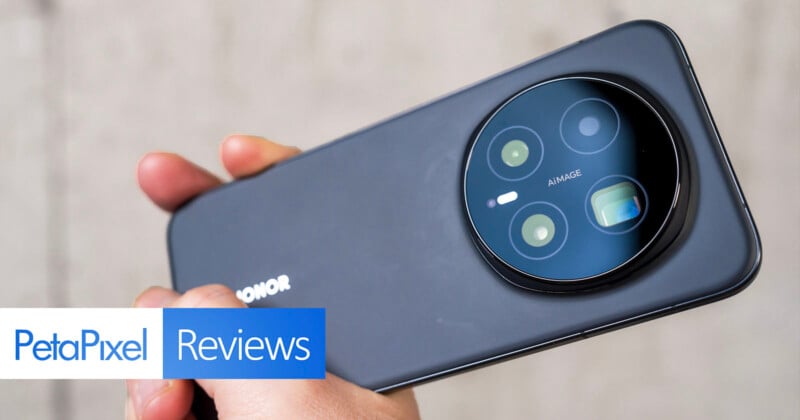
The Honor Magic 8 Pro is part photography upstart and part AI canvas in how it approaches still photos, relying more and more on what machine learning can do along the way.
The phone features the first CIPA-rated 5.5-level optical stabilization system for its 200-megapixel telephoto camera, though it’s not immediately clear whether the rest of the rear camera system receives similar physical upgrades. The AI-driven software plays a big role in what kind of images you can produce using all of the cameras.
All of that is up against tough competition from the same place (China), and while it doesn’t get North American availability, its presence on shelves in Europe and other markets makes this a serious player. Besides, importing is always an option for those in North America.
Honor Magic 8 Pro Review: Design and Build
There’s no radical change as far as what the Magic 8 Pro looks like relative to its predecessors. A circular camera module with a similar brushed metal finish and a fairly thin profile. It’s an elegant phone by any measure, even if the rear camera module sticks out a bit.
Part of the reason it does is that Honor opted not to make any dramatic changes, with dimensions and weight only showing marginal differences. There’s also no built-in MagSafe capability, leaving that to third-party cases.
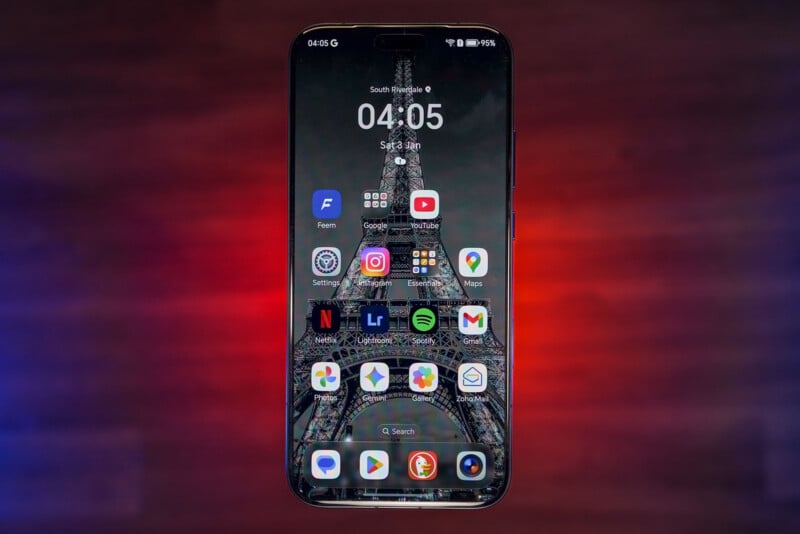
It’s not often a brand shaves down screen size, but the Magic 8 Pro has a slightly smaller 6.7-inch (2808 x 1256) OLED screen this time. Not that it makes much of a functional difference anyway. Aside from being brighter and offering more eye comfort features, it still has Honor’s NanoCrystal Shield glass protection, 1-120Hz dynamic refresh rate, and settings options as its predecessor. As before, Honor uses the Vivid color setting for the screen, now joined by Professional, a more color-accurate option that I tend to use more often. The ultrasonic fingerprint sensor also carries over from the 7 Pro, maintaining a key upgrade from the previous model.
Durability also doesn’t change much unless you count the IP69K protection that goes with the existing IP68 and IP69 dust and water protection the device already has. The most common model starts at 12GB of RAM and 512GB of storage, with others going up to 16GB and 1TB.
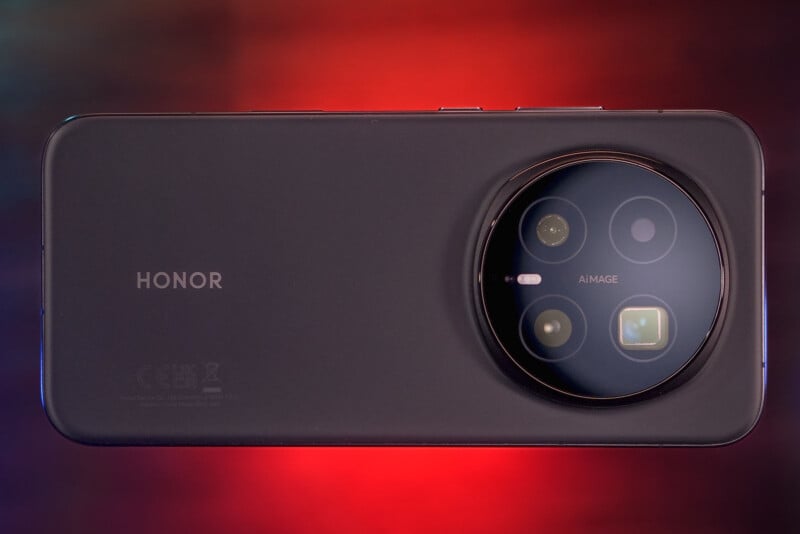
The Snapdragon 8 Elite Gen 5 processor is an upgrade under the hood, though I would argue the bigger impact comes from the 6,270mAh silicon-carbon battery. While smaller than the 7,000mAh+ batteries for the global and Chinese versions (my review unit is a European variant), it’s still huge for a phone this size. Unsurprisingly, it outlasts just about any phone that’s readily available in North America, with only the OnePlus 15 coming close. Use the right charger, and it can fully charge in about 45 minutes.
Honor Magic 8 Pro Review: Pushing the AI Button
New to the Magic 8 Pro is an additional button along the right edge, Honor calls the AI Button. In many ways, this emulates Apple’s Camera Control and Oppo’s Quick Button, particularly in the latter case because it doubles as both a photography and AI shortcut. Double-press to launch the camera, light-press to apply focus (though you can’t move the focal point away from the center of the frame), and carefully swipe to zoom in or out. Hold it down to shoot in burst or record video.
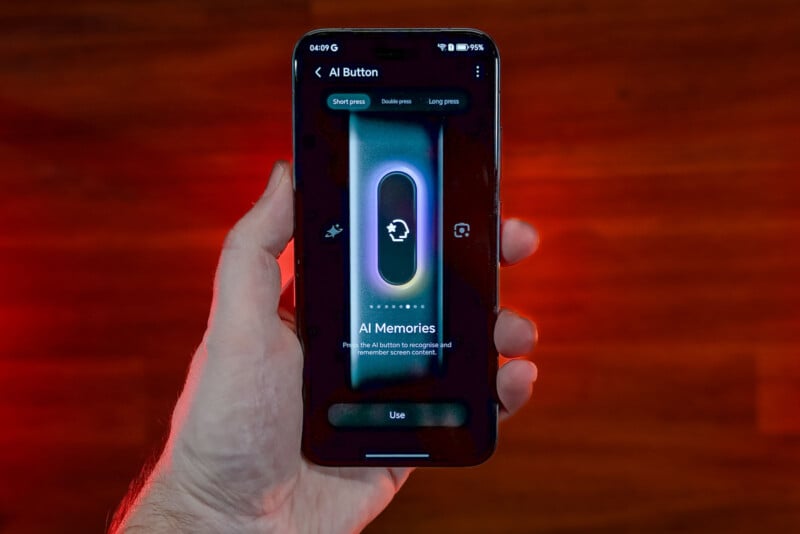
That’s for camera features; you can also customize it outside of that. Among the options are things like AI Screen Suggestions, AI Settings Agent, Honor AI, AI Memories, and Google Lens. You have the choice to assign three based on a short press, double press, or long press.
The key camera features through this menu shortcut to launch the camera app and AI Photos Agent, a separate editing tool that lets you apply AI-driven editing effects or generate cartoon, animated, watercolor, or sketch versions of an existing photo. I’m not clear on what exact AI model Honor taps into for this, but results sometimes leave plenty to be desired. In addition, you can skip launching the camera app this way and just double-click the power button to do it instead.
The AI Settings Agent is a chatbot within the phone to access features in the settings. Unlike the photo editing features, this one works on-device, so no cloud is necessary, except it turns out to be a dud most of the time because it doesn’t dig particularly deep. I would routinely run into “I can’t configure this feature” responses, limiting any utility the built-in AI could serve as an onboard agent.
AI Memories is odd because it’s not always clear where the screenshots go, so I recommend Screen Suggestions as a better alternative given how it offers the option to use Google Circle to Search or save what’s onscreen to AI Memories anyway. It’s also contextual, suggesting editing tools for photos, deepfake detection for video, summarizing web pages, blurring private information, or displaying subtitles.
Much of this AI suite is easy to move past, but deepfake detection is particularly interesting because it’s no longer a beta or concept feature. It’s also on-device thanks to training from “vast collections” of images and videos, enabling it to flag AI-generated video during calls. Once enabled, it can do this in real time by analyzing the other party’s face for any sign of manipulation on popular apps like Zoom, Teams, and WhatsApp. This also extends to voice cloning during phone calls to identify synthesized or cloned voices.
Honor Magic 8 Pro Review: Camera Features
Honor’s headline feature for what it’s calling its “AiMAGE Camera System” is the 200-megapixel Ultra Night telephoto camera (85mm equivalent), using what appears to be a Samsung Isocell HP9 Type 1/1.4-inch image sensor with a periscope design, f/2.6 aperture, and optical image stabilization. Tap it again in the camera app, and the default 3.7x zoom crops in closer for a 170mm equivalent hybrid zoom. The 10x zoom is a 230mm equivalent, though tapping it again crops in even more to 340mm.

Honor claims retained detail at these obviously processed hybrid zooms is a noticeable improvement, and while not wrong, results are sometimes luck of the draw. It’s actually an inconsistency that shows itself in other ways using the camera, leading to a mix of fantastic and ordinary results.

As is often the case with Honor, it chooses to be mysteriously coy about its chosen image sensors. The 50-megapixel main camera (23mm equivalent) has a Type 1/1.3-inch sensor with f/1.6 aperture and optical image stabilization. The previous model likely used a variant (or actual) OmniVision OV50H sensor but I can’t confirm that yet. Either way, they are pixel-binned down to 12.5 megapixels unless you use the High-Res or Pro modes for full-res JPEGs. Strangely, Honor chooses to limit RAW output to 12.5 megapixels as well.

Notably absent is the variable aperture Honor included in the previous 7 Pro, essentially replacing it with nothing similar. You can adjust a virtual one in Portrait mode, but that’s about it.
The 50-megapixel ultra-wide (12mm equivalent) may or may not be using the same OmniVision OV50D 1/2.88-inch sensor with f/2.0 aperture. It’s the weakest link of the group, as is, though Honor fortunately offers the chance to shoot at full-res with all three rear lenses at their default optical range.
Honor Magic 8 Pro Review: Software Features
With so little changed on the hardware side, it leaves software computation as the most likely differentiator. The thing about Honor’s software is that it slaps “AI” on everything it can name, which feels like an overloaded medley of disparate tools. That’s not necessarily always true in practice, given there are several that complement each other or come presented in a group, much like they continue to be in the Gallery app’s editing suite.
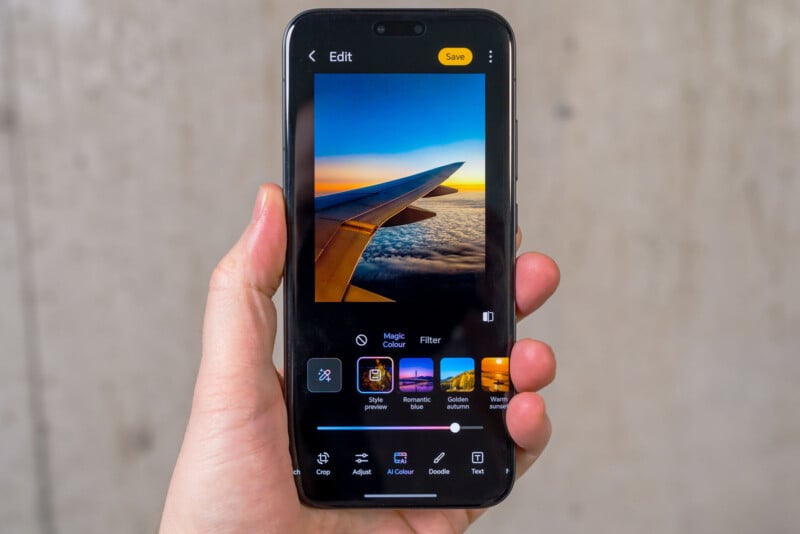
However, they split up or overlap in some ways. For example, the AI Edit section in the Gallery app is wholly separate from AI Photos Agent. It presents a different editing interface with multiple AI-driven options, like removing reflections, removing wrinkles, color enhancement, and removing passersby, among others. Results are very hit or miss, making it more of a crapshoot as to whether the cloud-based AI makes a meaningful difference.
The bigger impact may be in how it handles color. AI Magic Color appears when you tap AI Color in the Gallery’s editing suite. Honor has three of its own palette filters to choose from: Romantic blue, Golden Autumn, and Warm Sunset. You can apply any one of these to a photo or create your own using an image from your own photo gallery.

I wasn’t sure how I’d feel about such a feature, but I actually grew to like it a little bit. While I much prefer manually editing photos to get the look I have in mind, I can see it resonating with users who like experimenting. A slider lets you control the effect’s potency but not the angle or saturation of the colors themselves. You can take photos using these palettes directly from the camera app, along with the Vibrant, Natural, and Authentic photography styles we’ve seen from past Honor phones. Film filters are also available, which can sometimes lead to interesting results, but it would’ve been better if Honor sought to emulate classic film stock rather than coming up with its own presets.
Knuckle Circle is back (when you turn on Magic Portal under Honor AI), letting you circle anything onscreen with your knuckle to drag-and-drop into an app that appears in the side menu. It’s still pretty neat and works with a wide range of content, be it highlighted text, screenshots, products in videos, messages, emails, and notes.
Honor Magic 8 Pro Review: Image Quality
Honor is the one Chinese brand that doesn’t have an imaging partner to influence its general style. Apart from the Studio Harcourt (from Paris) modes in Portrait, the rest of the camera system relies solely on Honor’s own processing sensibility. With the Magic 8 Pro, more of the focus leans on night and low-light photos, though slight shifts in processing ultimately affect every shot you take.

This phone is kind of like a roulette table. The ball goes around, and when it hits the number you bet on, it’s naturally a feel-good win. That’s sort of how certain photos can turn out, yet results are fortunately more often appealing than vexing. The Vibrant style definitely brings out more color, whereas Authentic dials it back and adds slight vignetting for some reason. Natural was my personal go-to because it didn’t exaggerate all that much, keeping Vibrant as an option when I felt some color pop would do right by an image.


Much like previous Magic Pro models, movement can mess with dynamic range and white balance under certain conditions. It affects low-light shots more than daytime ones, but again, it’s hard to predict when and where. For instance, the barbecue grill flame took several shots because the fire itself was either overexposed or came out a little blurry. I don’t mind taking extras to get the right shot, but I can’t tell you for certain what went right with this one.
I’ve said it before and will say it again: Honor should consider a native white balance slider like the one Google has. There’s too much of a tendency to skew warm here, even when the ambient lighting doesn’t warrant it. However, you might take two shots — slightly shifting the angle — and end up with differing color temperatures.
I don’t point all this out to denigrate the camera’s performance, more to underscore that it’s that much closer to hitting another high. I know Honor loves AI, but resisting the urge to let it run its course with greater impact in processing images would be a wise choice. There’s a balance between sharpness and softness that’s not unattainable based on what I saw with this phone.
Despite being crop factors, I often took advantage of switching the main camera to 28mm and 35mm equivalents because it reduced distortion when capturing subjects from shorter distances.
Honor Magic 8 Pro Review: Telephoto and Ultra-wide
Since Honor claims the bigger jump lies in the telephoto camera, I was curious to see how. Off the bat, it’s not on the same level as the Vivo X300 Pro, both in sharpness and composition. But it’s also quite good at avoiding over- and underexposing images. The 200-megapixel number looks good on paper without offering much in low-light settings. Going with 50 megapixels is the better route when you want more resolution.



While I would completely agree that the Magic 8 Pro pulls off better composition than its predecessor, the strengths and weaknesses tend to be fairly clear. Action shots are still a challenge, as I witnessed at numerous events. Faster action, like sports or musicians on stage, can make things really interesting in whether you strike gold or keep on pressing the shutter. I experienced both while engaging Motion Sensing mode for the main and telephoto cameras. My sense is that Motion Sensing primarily works like center-weighted metering by looking for movement in the middle and basing capture settings on that. Shooting in bursts can alleviate that, but unless it’s able to track the main subject, focus just sticks to the same point.

The good thing is the telephoto still feels versatile. It captures excellent macro shots, though the focal plane is a little too tight for my liking. Portraits are nice, offering a nice mix of details and softness that can work well for people, pets, and food. Low-light shots are better and more varied, with more reliable focus to boot. I tended to use this lens more than the main or ultra-wide.
The ultra-wide isn’t going to impress all that much, but when it hits, it hits. With decent ambient lighting, it arguably performs better at night than it does in brighter settings. Your results will vary pretty widely, with High-Res mode offering the most flexibility in post upon capturing a full-res image.

Honor Magic 8 Pro Review: Video Features
I leaned in mostly on still photos but took a fair bit of video and liked shooting in LOG and experimenting with the included LUTs. The quality isn’t bad at all, even in low light, except that exposure and dynamic range can shift when lighting enters the frame, as I noticed when taking footage at the Neon Museum in Las Vegas. The sudden shifts in brightness from the various signs tend to make transitions look a little awkward. Interestingly enough, this happens more with the regular video mode than it does with Pro video, whether it’s just manual settings or in LOG.
You can record in 4K at up to 120fps or 1080p at 30 or 60fps as well. Honor only makes 24fps available in LOG, and since it cut out Movie mode, there’s no way to do it in Pro mode under manual or auto settings. A strange decision. Another catch is that if you do apply any of Honor’s LUTs to a video while recording, it knocks the resolution down to 1080p/30fps for some reason.
Honor Magic 8 Pro Review: Finding a Clearer Path
What’s interesting is that the Magic 8 Pro demonstrates Honor’s focus on AI-driven features, whereas its Chinese competitors are trying to figure out the right processing formula. That’s not to say Honor totally ignores it here, just that it’s betting that users will like a more sharpened and popped look for their images. Some might, but when comparing images to the best of the best from the East, it’s easier to pick out which ones feel more like photographs.
Perhaps the calculation would be different if the dizzying array of AI features kept scoring hits but that’s not the case. They’re too nascent to produce a lasting impact. All this runs parallel to a phone camera that proves very capable of capturing excellent shots. I routinely outdid iPhone and Samsung users nearby who were surprised at what “that Chinese phone” could deliver. The benchmark for Honor’s standing in this arena isn’t what those in the West are doing, it’s what its fellow Chinese competitors keep on doing.

Are There Alternatives?
The Vivo X300 Pro already stands out for its outstanding system that gets an even bigger boost when paired with the Zeiss lens. I could easily say the same for the Oppo Find X9 Pro, even if the Hasselblad converter lens is more restricted. Xiaomi is set to launch a new flagship, but the 15 Ultra is still a heavy hitter with its solid Leica processing and color science.
On this side of the world, the OnePlus 15 is a superb phone let down by a neutered camera system. That makes the OnePlus 13 an attractive alternative. Samsung is also about to launch its latest flagship though we don’t know if that will just be another highly iterative refresh. Google’s Pixel 10 lineup has upside, but not the versatility Honor can project with the Magic 8 Pro. Try shooting action on one of those and you get the picture. That’s also a weakness of the iPhone 17 Pro and Pro Max, though iOS users who’d prefer to stay in the garden have those options.
Should You Buy It?
Sure, if the AI presence is especially appealing. At roughly $1,275 after conversion, it’s not necessarily cheap but also comes in cheaper than competing flagships on both sides of the world.






 English (US) ·