.png)
 5 days ago
15
5 days ago
15
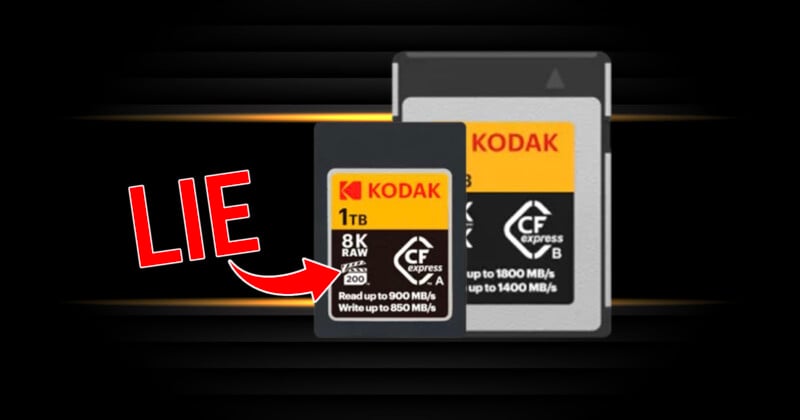
It’s no secret that Eastman Kodak will license its branding to pretty much anyone and one recent example of this is a series of Kodak-branded storage and memory products. They promise some very impressive performance at a fraction of the cost of major brands, so what’s the catch?
I first came across these memory cards on Threads, where photographer Gene Perez said he picked one up because the price was just so appealing.
These Kodak-branded cards are very affordable, so I can understand why he was willing to give them a shot. Plus, even though Kodak obviously isn’t manufacturing memory cards, there is something to be said about the brand name and the trust it carries — despite the fact it is pretty well-known that the brand is licensed out like we give out candy on Halloween.
These cards are available on Amazon, Walmart, and Wish (that’s a red flag straightaway; more on that later) and the 1TB version is just $179. To put that in perspective, Pergear’s 1TB CFexpress card is $257 (and that’s a bargain brand) while Lexar and Delkin Devices ask $450. OWC Atlas Ultra and ProGrade Digital cards cost $480. Going with Kodak — or, at least what appears to be Kodak — means being able to buy two or three cards for the price of one from the competition.
Part of the reason these cards are so much cheaper is likely due to the dated format they’re using. Looking at the peak speed performances they promise — 1,800 MB/s read speeds and 1,400 MB/s write speeds — the Kodak cards are operating on the older CFexpress 2.0 specification. Still, since no camera is currently equipped with CFexpress 4.0 contacts (the speed boost from 2.0 to 4.0 only applies to memory card readers attached to a computer), that probably doesn’t matter to many who would use them.
With the price as low as it is, it probably sounds too good to be true — and there is reason to believe that it is. To understand that, though, it’s important to first dig through the nesting doll company situation that these cards are created under. Firstly, Dexxon in France is the company with the license to the Kodak brand name for memory products. Dexxon then appears to have sub-licensed it to Futurepath Technology, a Shenzhen, China-based memory manufacturer.
The good news is that Futurepath Technology is a proper Compact Flash Association (CFA) member, meaning they have access to the right licenses and technology to legitimately manufacture cards.
The bad news is that the company isn’t playing by all the rules of that relationship.
While it doesn’t apply to its CFexpress Type B cards, Futurepath Technology is labeling its Type A cards with the Video Performance Guarantee (VPG) logo, advertising them as VPG200 verified. That is a lie, as there is no reference to Futurepath, Dexxon, or Kodak on the approved VPG list and the CFA confirms to PetaPixel that it has no record of any of those brands even applying for VPG verification.
This is exactly the same shady behavior that PetaPixel pointed out two years ago, where brands were faking the firmware flag for VPG200 to trick Sony cameras into thinking they had gone through the proper channels when they in fact had not. Remember, Sony requires VPG200 verification to access certain video modes on certain cameras, so many brands were faking this flag to avoid going through proper verification, which is time consuming and required that the cards actually perform in extreme circumstances. By skipping this step, the cards could be sold for much cheaper and their performance isn’t actually guaranteed.
And when these cards fail, good luck getting any recompense or even a response from the parent companies.
Six months after PetaPixel‘s report on fake VPG verification, the industry largely cleaned up. Still, there are outliers and Kodak is among them. Memory brands, specifically those in China, regularly try and skirt the rules. Lying to customers is worth it to make a buck, apparently.
Perez says that in his limited testing, he hasn’t found any issues with the Kodak-branded CFexpress Type-B cards, and that tracks. In his Nikon ZR camera, it’s unlikely that he is pushing these cards to the limit. Beyond that, cards like these Kodak-branded ones will unlikely fail up front. Instead, it is more likely that they will not last as long, failing a photographer or filmmaker after being used for a few months or a year.
Failures can be as hard to spot as a dropped frame or two in high-framerate video clips to catastrophic full-on card failure that locks a user out of access to anything on it. Given the low price and the demonstrated willingness to straight-up lie to consumers, it’s very unwise to put faith in cards like this.
Stop Cheaping Out on Memory
I said before that Kodak cards being available on Wish was a red flag, and that’s because the memes around Wish are memes for a reason: that’s not a reputable place to buy anything.
If a company is willing to lie about VPG verification, you have to ask yourself what else it’s willing to lie about and what other corners it is cutting to get its asking prices down to a fraction of the competition.
It never ceases to amaze me how often photographers and videographers will purchase a nice, high-end camera and then proceed to put in the cheapest memory card they can find into it and cross their fingers. Memory is the single most important aspect of any camera system and yet photographers will regularly choose to cheap out on that aspect straightaway. It’s maddening.
Your camera is only as good as what it is recording to. I get trying to save money, but if you’re going to spend the cash on a nice camera, spend the requisite amount to make sure you can actually keep what it records.
Image credits: Elements of header photo licensed via Depositphotos.






 English (US) ·