.png)
 2 hours ago
1
2 hours ago
1

Published Jan 31, 2026, 1:00 PM EST
But let's talk about that ending, and the small, important question: Where's Josh Gad?
 Image: Disney Plus
The entire eight-episode season of Marvel Studios’ latest (and maybe best?) Marvel Cinematic Universe series, Wonder Man, landed on Disney Plus on Jan. 27 — good news for impatient TV bingers, bad news for the show itself. Creators Destin Daniel Cretton and Andrew Guest seem to have designed the show for more of a week-to-week cadence, with rising tension, escalating stakes, and a lot of little side stories that would have been fun to savor, unpack, and discuss, rather than watching the fandom blow past all of them all to get to the ending.
But what an ending Wonder Man has. The series wraps with a slow-burn, unhurried character examination that makes it feel like Cretton and Guest have all the time in the world — until they suddenly hit the kind of action moment that MCU fans have come to expect from the franchise. Disney has described Wonder Man as a miniseries rather than an opening season for a continuing show, but that miniseries ends on a moment designed to leave the audience wanting more. The show’s last moment is also its first concession to Marvel Studios’ usual “Tune in next time, true believer!” storytelling ethos.
So let’s talk a bit about that ending — what it does and doesn’t say about what Wonder Man was doing all along, where the characters are poised to go from here, all the biggest questions Wonder Man never answered, and why the biggest one of all isn't the question we should be asking.
[Ed. note: Full end spoilers ahead for Wonder Man.]
 Image: Disney Plus
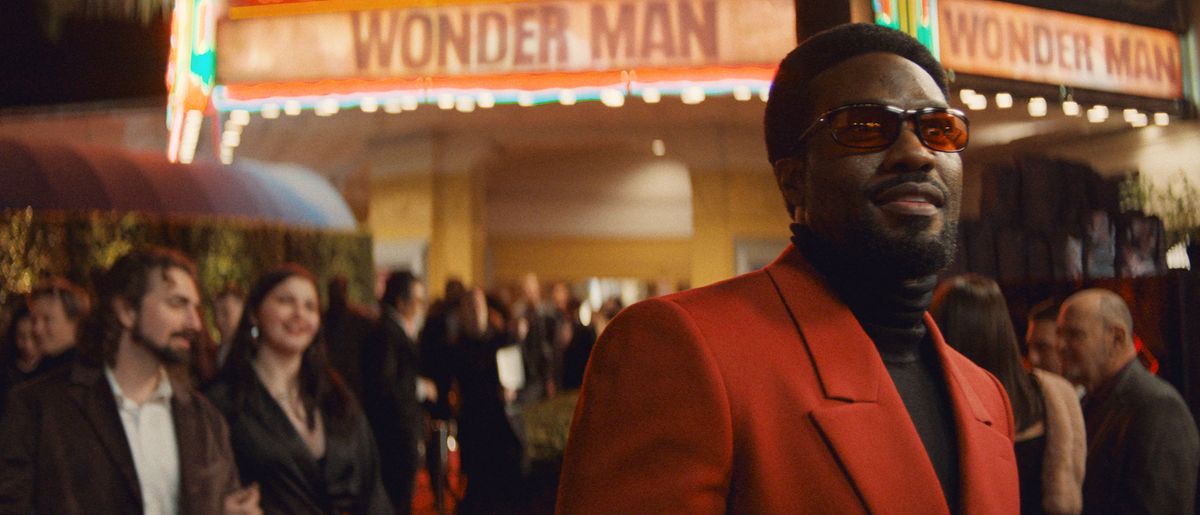
Most of Wonder Man is devoted to struggling Hollywood actor Simon Williams (Yahya Abdul-Mateen II) hungering after a role in the rebooted superhero movie Wonder Man, trying to manage the anxiety that causes him to lose roles and causes his secret telekinetic powers to act up and destroy things around him, and slowly building an unexpected friendship with Trevor Slattery. You might remember him as the washed-up actor who disgraced himself internationally by playing a terrorist called The Mandarin as a front for a villainous scheme.
For most of the season, Simon doesn’t know that Trevor is spying on him on behalf of self-serving government flak (and recurring MCU low-level baddie) Agent Cleary from the Department of Damage Control. He wants to jail Simon as a dangerous high-powered threat, mostly to justify the budget for a high-security prison for superpowered people. When Simon does find out — after he and Trevor land the career-changing lead roles in the Wonder Man remake — it shatters his confidence and the growing friendship between the two men. Simon’s power flares out of control and destroys a sound stage at the studio producing Wonder Man, putting Simon at risk of discovery and arrest, not to mention the end of his acting career.
But Trevor, regretting his betrayals of Simon, resumes his role as The Mandarin, pretends he bombed the studio, publicly takes the blame, and winds up in the super-prison where Simon would have been incarcerated. In the finale, Simon uses considerable acting skills, his Wonder Man fame and riches, and his now-under-control powers to break Trevor out of prison, and they fly off into the sunset together.
What’s next for Simon and Trevor after Wonder Man?
 Image: Disney Plus
Wonder Man’s final scene isn’t just an open-ended tease for the future. Cretton and Guest quite consciously leave the audience wondering how Simon went from helplessly smashing up rooms with his uncontrolled powers to confidently tearing apart a prison cell specifically designed to hold powered people, then flying away with Trevor in hand. They also leave open the question of where Simon and Trevor could possibly go from here. Both of them are now world-famous actors, and soon to be world famous as terrorists. Simon has outed himself as having superpowers, and will be ineligible to ever work in Hollywood again, because of the impossibly high insurance costs. Where can they go where they won’t be recognized, and how will they deal with ending their acting careers, given that the entire show is about how crucial performance is to both of them?
The best answer here is that while this is a huge question, it's an intentional one — and the answer doesn’t really matter to Wonder Man's story. By choosing loyalty to Trevor over fame, fortune, and his choice of high-profile Hollywood roles, Simon establishes how much Trevor has helped him grow as a person. He’s making a statement about how his values have changed, particularly in the wake of Trevor’s claim (to Joe Pantoliano, hilariously) that acting is the most important job in the world. His sudden jump from having no control over his powers to having complete control feels unlikely and abrupt, but it strongly suggests that his problems always stemmed from fearing, fighting, and repressing his abilities. The finale signals that getting the Wonder Man role — and with it, the public confirmation of his acting talents, and the long-withheld approval of his brother Eric — gave him enough of what he’s needed that he can willingly step away from his career in favor of something he cares about more.
If Simon’s story ever continues in the MCU, he’ll probably need to become a superhero — perhaps he can get a pardon for breaking Trevor out of jail by saving the world in an upcoming movie. But there’s no sign that Cretton and Guest are setting him up for future Wonder Man seasons or stories — the end of the show doesn’t feel like a tee-up so much as a payoff. Simon got everything he wanted from Hollywood, and instead of demanding more, he decided it was enough, and that he was willing to let go of it to save Trevor. In the process, he exorcised some of the demons that have haunted him since the childhood breakout of his powers. That’s a complete story in itself, and one that doesn’t necessarily need a next chapter.
How did Wonder Man get his powers?
 Image: Disney Plus
The series also doesn’t address why Simon has these abilities in the first place, which has raised a lot of questions among the MCU fandom — is he a mutant? Or the beginning of some new development in the MCU? Will his brother Eric eventually become a supervillain, as he does in the comics? Is Simon going to show up in Avengers: Doomsday? (Wonder Man in the comics was periodically associated with the Avengers, when he wasn’t dead. But he’s spent a lot of his history as a dead hero, between resurrections.)
There’s no clear answer here, apart from a sense that Cretton and Guest were working outside MCU continuity — a hallmark of series under the recent “no MCU homework necessary” Marvel Spotlight banner — and aren’t really invested in Simon’s origin story. That isn’t a particularly satisfying answer, though, not in a setting where superpowers normally come from some specific event that becomes an important part of a hero’s connection to the world and other characters.
Whatever happened with that New York Times story?
 Image: Disney Plus
This is a petty question, but it feels weird that Wonder Man devotes most of an episode to New York Times reporter Kathy Friedman (Lauren Weedman) and her planned profile of Simon, which leads her to interview his ex-girlfriend and family, and has him and Trevor on pins and needles about whether she’s going to do some sort of major hit piece on Simon, as she’s done on other actors. Arguably, the direction Wonder Man goes in makes Kathy’s take on Simon irrelevant. Not just because his story changes so much in such a short time, but because she’s another symbol of his anxiety, his fear that people will discover his powers, and his desperate need for validation and acting work — all issues that he triumphs over by the end of the series, in one way or another.
But it still ends up as a major subplot without a payoff. Kathy says to him at some point that she’s planning on writing a complimentary piece about his “inspirational” story, but it’s never really clear what she’s talking about. (Being a largely failed actor with a history of annoying his employers and collaborators but eventually getting a big role anyway is inspirational?)
For a while, I was convinced that between his ex’s heavily coded, non-specific “I know your secret” statement, Kathy labeling him as “inspirational,” and the dramatic stakes of a possibly career-destroying article about him hitting the papers, the whole thing was going to pay off in an unexpected, ridiculous way — specifically that his ex thought he was gay and closeted, hence his lack of connection with her, and Kathy supporting that notion with quotes from Simon’s mom and brother about his closedness and isolation. (Though hiding in the closet to get leading-man roles still isn’t very inspirational.)
It’s likely that Cretton and Guest are just signaling that Simon doesn’t need Kathy’s validation by the end of the story — not for his career, which has taken off, and not for any personal payoff, since he’s found the connection he needed in Trevor’s friendship. Still, it feels odd that a supposedly sharp journalist was excavating Trevor’s life, and that a huge event (the destruction of the Wonder Man sound stage) happened in his orbit while she was working on her piece, and that instead of prying further, she just disappears. Episode 7 is literally called “Kathy Friedman,” but by episode 8, she’s evaporated entirely, without any word one way or another about the artlcle. Sure, the real payoff of the subplot is Trevor being outed as a spy, but Kathy’s article remains an unfired Chekhov's gun, still hanging on the wall.
Where the hell is Josh Gad?
 Image: Disney Plus
I’ve never been a particular fan of Josh Gad, his Frozen character Olaf the Snowman, or the overall “adult theater kid” vibe he’s brought to roles like LeFou in Disney’s deeply regrettable live-action Beauty and the Beast or Hector in Kenneth Branagh’s Murder on the Orient Express. But Wonder Man makes him seem like a mensch, and suggests that his mysterious disappearance is a net loss for the world.
Episode 4, the silly standout flashback story “Doorman,” brings Gad in for an extended cameo as a version of himself, a high-energy, life-of-the-party Hollywood player who seems like he’s always one moment away from revealing himself as a shallow, selfish celebrity stereotype.
That heel-turn would be pretty standard for this kind of “struggles of Hollywood actors” story, but Gad never wavers in being a nice guy. He might seem like he’s being insincere when he invites nightclub doorman DeMarr Davis (Byron Bowers) to have a drink with him in the club, but we never get a moment where he goes back on that invitation, or treats DeMarr poorly. When DeMarr has a close encounter with some toxic goop spilling out of a Roxxon dumpster, and becomes a living interdimensional gateway, Gad honestly seems happy and impressed.
When he hires DeMarr away from the nightclub with a hefty salary bump, he seems to treat him more like a friend than an employee. And when DeMarr gets famous in his own right, Gad seems entirely supportive, instead of jealous or proprietary about losing his bodyguard and personal on-call micro-superhero. So when Gad trustingly enters DeMarr’s body-gateway during a film stunt, and never emerges, it seems like a tragedy not just for DeMarr, but for Hollywood. Is DeMarr’s nightclub really never going to get another command performance from Gad doing an electro remix of Olaf’s Frozen song “In Summer”?
Sometimes, going back to the source material can help clear up an MCU show’s unaddressed mysteries, but in this case, DeMarr’s Marvel Comics history is no help. The comics version of Doorman is a mutant tied to the Darkforce Dimension, which other Marvel characters have accessed in one way or another: Most prominently, Cloak of Cloak & Dagger can transport people there, and he channels Darkforce energy as part of his power set.
In a Marvel Comics setting, if someone got lost inside of Doorman’s portal, there would be heroes who could help — or villains, at a price. In Wonder Man, Doorman’s power set is an enigma, and so is Josh Gad’s fate. I was really hoping for a post-credits scene where he pops back into reality in some unlikely place, like John Cusack and company being dumped out of John Malkovich’s magical head-portal onto the side of the New Jersey Turnpike in Being John Malkovich.
Will we ever see Doorman again in the MCU? Here’s hoping so — his episode is a blast, and if he hasn’t overtaxed his powers too much to regain them, he’d be a fun cameo for any MCU project. Will we ever see Gad again? Who knows, maybe he’s serenading some alternate-universe dark-dimension gods and monsters somewhere, with his greatest-hit selections from The Book of Mormon.





 English (US) ·