.png)
 2 days ago
10
2 days ago
10

Step inside Seb Agnew’s cinematic, narrative-driven worlds, where miniatures and real sets reveal complex human experiences. Each image invites viewers to imagine what came before and what comes after, turning everyday spaces into dreamlike, thought-provoking scenes.
For Seb Agnew, photography is never just about capturing a moment; instead, it is about creating entire worlds, each carefully constructed to convey meaning. With over twenty years of experience in image-making, Agnew’s journey into photography began during his studies in Audiovisual Media, where his fascination with storytelling and conceptual imagery took root.
“Working on a film set did not appeal to me because I wanted to fulfill more than one role at a time. I wanted to be the author and director of the story, and I wanted to be in charge of lighting, set design, and post-production,” Agnew says.
Photography became the perfect medium for him. It allowed Agnew to combine narrative depth, visual experimentation, and complete creative control, bringing his imaginative ideas to life in ways that filmmaking alone could not.

Narrative and Miniature Worlds
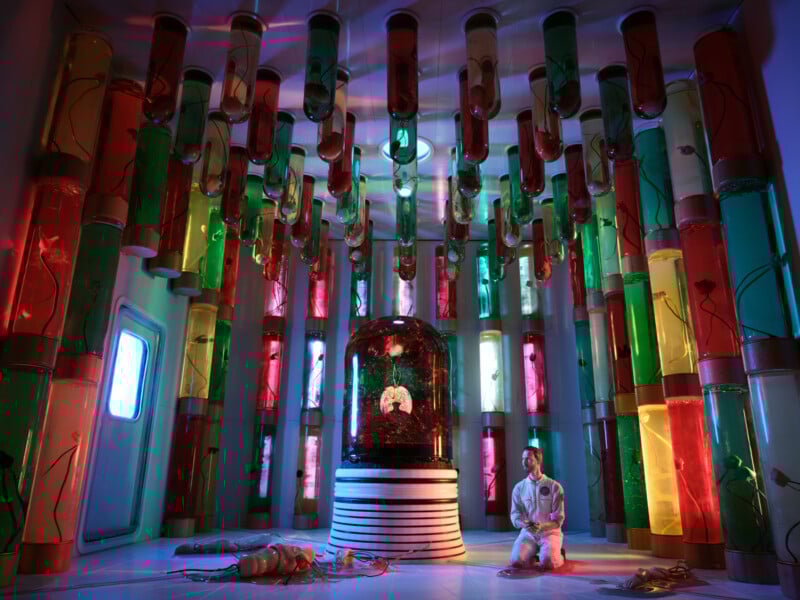
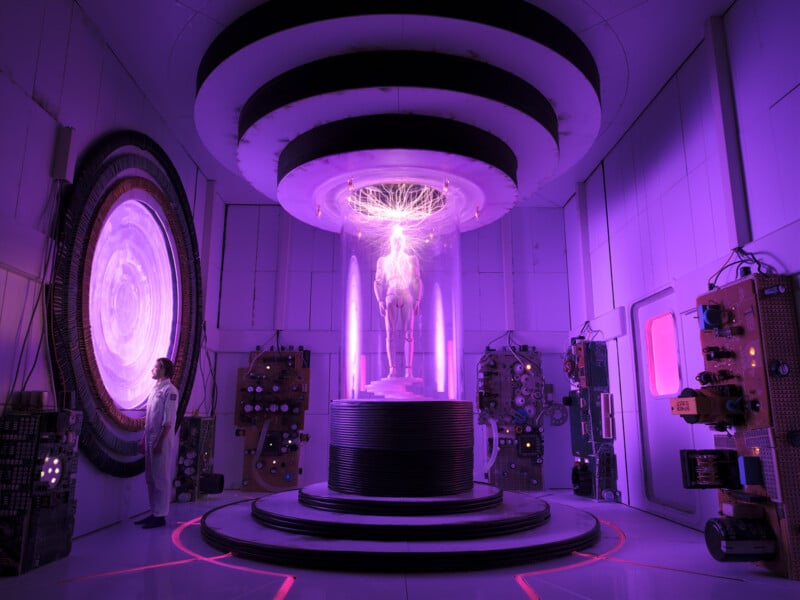
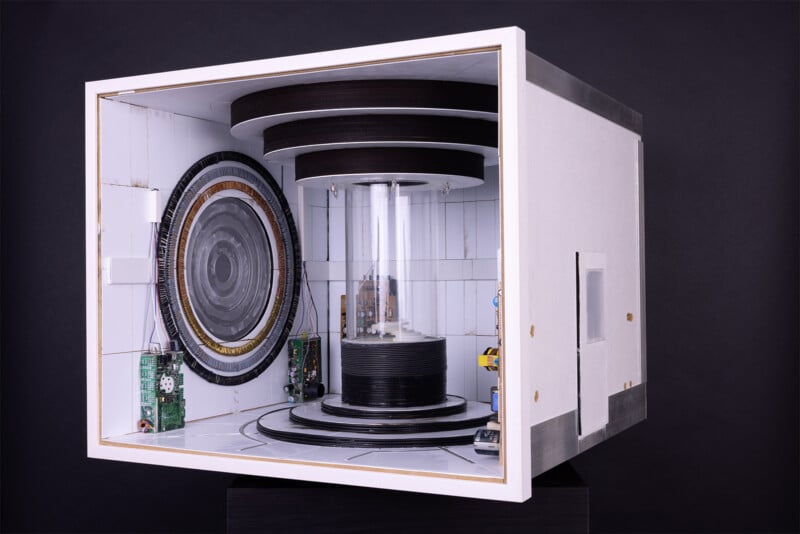
Agnew’s work is instantly recognizable for its cinematic, staged quality. He transforms ordinary spaces such as living rooms, basements, and everyday settings into surreal, dreamlike tableaux that explore the human condition. Some scenes are staged in real locations, while others are built as miniature dioramas that are photographed to appear life-size. This blending of reality and fiction is central to his ongoing series, CUBES, which has evolved from domestic spaces into imaginative, science fiction-inspired environments.
“I have always been a big fan of miniatures in stop-motion films and the use of dioramas for visual effects in feature films, which is why incorporating this technique into my creative process was both inspiring and liberating,” Agnew says.
The transition to miniature sets was prompted by practical considerations as well as creative curiosity. In the early years, Agnew worked exclusively in real locations, including his own flat. As his productions became more elaborate, his home became difficult to live in, leading his wife to suggest creating smaller sets. He embraced this idea literally, which gave birth to the miniature dioramas featured in CUBES. This approach allowed him to experiment with scale, perspective, and intricate detail that would be impossible in full-size rooms.
His miniature sets often incorporate highly unusual elements to challenge perception and create visual intrigue. For example, one motif from CUBES I involved covering an attic floor with 25,000 playing cards. Another motif is cooked spaghetti hanging from the ceiling in a basement, a task that requires both patience and ingenuity. Agnew recalls the intense learning process with a mix of humor and humility.
“I can’t remember how many times I cut myself with sharp knives, glued my fingers together with superglue, or accidentally destroyed delicate elements just before a set was finished. But it taught me that there are no creative limits and that it is worth believing in a crazy idea and seeing it through to the end,” Agnew explains.

Storytelling Through Image
At the heart of Agnew’s photography is storytelling. Every image functions as a narrative node, inviting viewers to interpret the story, imagine what came before, and consider what might follow.
“Being able to tell an entire story – and offer countless interpretations – with just one image is the most rewarding aspect of capturing an image for me,” Agnew says.
Agnew approaches his work with careful planning and a mix of classic creative methods such as brainstorming, mind mapping, and observation of everyday life. Many ideas come to him during long walks or jogs in nature, and he values frequent discussions with his wife, who provides critical feedback and perspective. Each series revolves around a central theme, and Agnew’s goal is to create images that remain open to interpretation.
“I like it when stories remain open, when I am allowed to have my own conclusions and interpretations. The interesting thing about life is usually not the answers, but the questions themselves. For me, mystery remains exciting until I know the solution, and I try to preserve that feeling in my pictures,” Agnew says.

The CUBES series, in particular, is an exploration of the micro- and macrocosms of human existence. Each chapter contains nine images that are interconnected thematically, exploring existential questions and the concept of human interconnectedness. In CUBES III, Agnew moved into a fictional, futuristic setting with a rotating space station called Helios-9. This chapter investigates humanity’s relationship with technology and artificial intelligence while also serving as a playground for integrating AI into his creative process, from moodboarding to brainstorming ideas.
“Who is the creator? Does man inspire the machine, or vice versa? And where are we headed with all these powerful technological possibilities in the long run?”


Technical Mastery and Creative Challenges
While equipment is secondary to his vision, Agnew ensures that his technical tools meet the demands of his intricate imagery. He currently works with a Fujifilm GFX 100S medium-format camera, using a fixed focal length equivalent to 30 millimeters on medium format. He relies on artificial lighting for atmosphere and storytelling. Speedlights are used for real locations with limited space, while continuous lights illuminate miniature sets with precision. Depending on the complexity of a set, he may use anywhere from one to ten light sources.
“When building miniature sets, I use 3D printing and laser cutting to achieve a maximum level of detail and precision,” Agnew says.

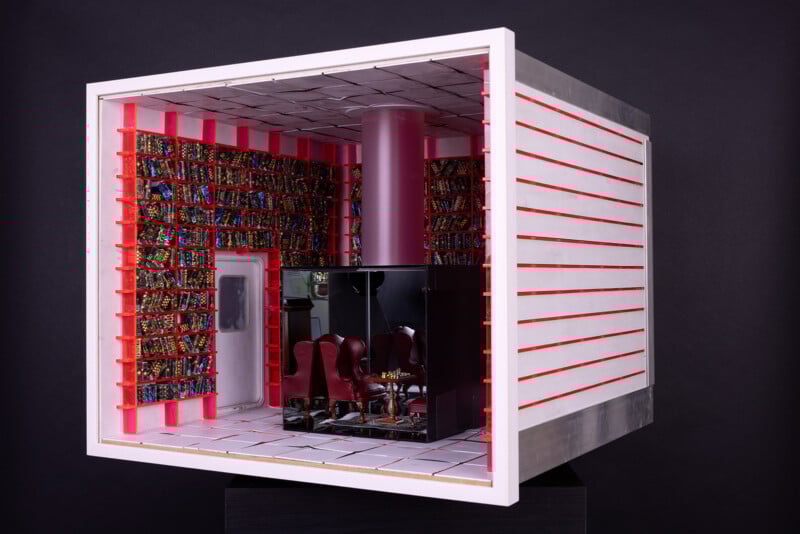
Agnew’s attention to detail extends beyond the camera and lighting, props, colors, and set design are all chosen for their narrative and symbolic significance. He approaches each scene like a painter, selecting every element to guide the viewer’s attention, evoke emotion, and reinforce the story.
Overcoming technical challenges is a central part of Agnew’s creative journey. Ambitious sets often involve unusual materials or extreme conditions, from working in summer heat to handling fragile miniature components. Many ideas that were impossible at full scale were realized in miniature, opening new possibilities for creative experimentation.
“Challenges motivate me enormously. I prefer to work alone, but I am more than grateful for the help of my family during particularly demanding shoots,” Agnew says.
Philosophy, Themes, and Future Projects
Recurring themes in Agnew’s work include the human condition, disorientation, and the search for meaning. His images often reflect on society and human behavior, using surreal or dreamlike environments to highlight universal questions. While CUBES III engages with technology and artificial intelligence, earlier chapters focus on domestic spaces and intimate human interactions, highlighting both the extraordinary and mundane aspects of life.
“I developed my own workflow and taught myself how to work with miniatures without any prior experience in model making. It all started with a vision and the desire to turn my ideas into reality, leading to countless challenges and learning moments along the way,” Agnew says.
Agnew views photography not only as an art form but also as a dialogue with the viewer. He intentionally leaves narratives open-ended, allowing interpretation and imagination to complete the story. Each image is a carefully controlled moment that invites reflection on what preceded it and what may follow.
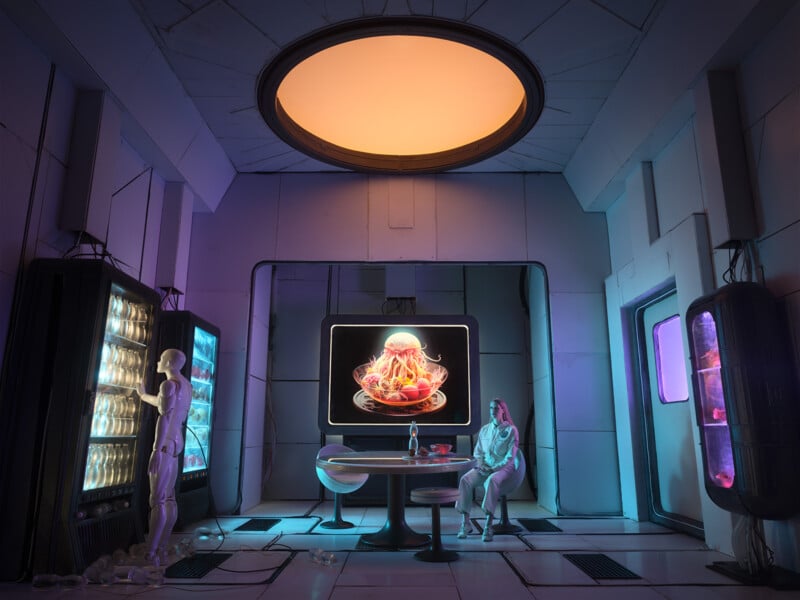

Looking ahead, Agnew is preparing to release an art book dedicated to CUBES and plans to exhibit the entire series, including the accompanying dioramas. He is also conceptualizing a new body of work, promising fresh explorations while remaining true to his cinematic, narrative-driven style.
“It is definitely worth following my posts and stories on Instagram or subscribing to my newsletter,” Agnew says.
Seb Agnew’s photography demonstrates patience, imagination, and meticulous craftsmanship. Through his staged, narrative worlds, he invites viewers to look, imagine, question, and explore the boundaries of human experience, one carefully crafted frame at a time. His work shows that with vision, dedication, and a willingness to experiment, even the most ambitious creative ideas can become reality.
Image credits: Seb Agnew





 English (US) ·