.png)
Paramount
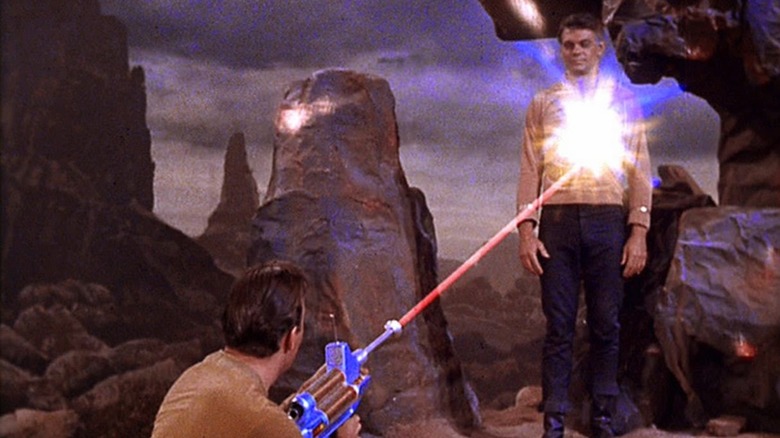
Back in the mid-1960s, when Gene Roddenberry was first spitballing the sci-fi technology he wanted to use on his sci-fi series "Star Trek," he was drawn to the idea of making things sound as realistic as possible. True, "Star Trek" is replete with impossible imaginary tech like faster-than-light travel, matter transporters, and food replicators, but all of the fantastical widgets have a finger back in reality, making them seem like they might actually be possible someday. Roddenberry wanted his space-bound characters to wield lasers as weapons, thinking that they would supplant projectile weapons like guns and that they would be non-lethal. When Roddenberry looked into modern, '60s-era laser tech, however, he found that a lot of what he was writing into his sci-fi show had already been invented. As such, he changed the name of Starfleet's weapons from lasers to phasers, thinking that would sound more futuristic.
Phasers have been a common element of "Star Trek" since the beginning, and the phrase "set phasers on stun" has leaked into the pop lexicon, even outside of "Star Trek" circles. The sound the phasers make — a prolonged, high-pitched trilling — is deeply embedded in the brains of Trekkies everywhere. It was used dozens of times throughout the run of the 1966 series.
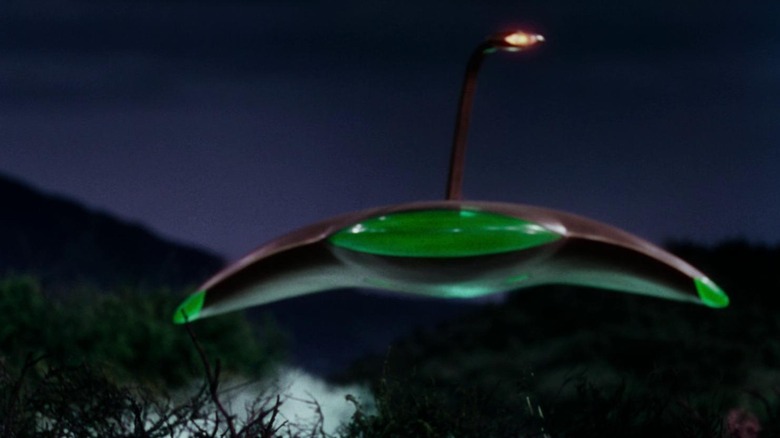
The phaser sound was once analyzed by sound designer, editor, and director Ben Burtt, perhaps best-known for his sound work on "Star Wars" movies and the "Indiana Jones" franchise (but with dozens of credits besides). Burtt spoke with TrekMovie back in 2009, and with the sharpest ears in the business, he was able to identify that the phaser sound effect was actually a repurposed version of the Martian warship sound effects from Byron Haskin's 1953 movie "War of the Worlds."
Star Trek's phasers used the same sound effect as the Martian ships in War of the Worlds
Paramount
When a Trekkie watches clips of "War of the Worlds," the sound is incredibly obvious. It's very clear that the makers of "Star Trek" cleanly stole the Martian sound effect. Ben Burtt not only knew that the phasers were the same sound effect, but he knew how the effect was made. He described it like this:
"In the original series, the steady blast of the phaser was derived from the hovering sound of the Martian war machines made for the 1953 version of Paramount's 'War of the Worlds.' The original was made with tape feedback of an electric guitar and a harp. You can achieve a very similar sound on a Moog synthesizer by modulating a steady sine wave with pink noise."
You've likely heard of a Moog synthesizer. The term "pink noise" is industry lingo for the loud, hissing static that one might have heard from an old TV with no signal. The sine wave, as it is used in regards to sound design, represents a steady, non-fluctuating sound. One can see sine waves visualized through your average oscilloscope, and they sound like a sliding electric hum, its pitch determined by the wave's frequency. It seems that one can create a phaser effect — or rather, a Martian war machine effect — with an old synth that can produce a steady electric hum, altered by the "fuzz" of pink noise. It's all very simple — at least for someone like Ben Burtt, who no doubt has those objects around his house.
Burtt did sound work for the rebooted "Star Trek" movie in 2009, as well as its sequel, "Star Trek Into Darkness."







 English (US) ·