.png)
 7 hours ago
1
7 hours ago
1
In most recent years, NASA considered using the Propulsion and Structural Test Facility to support the Constellation program and its Ares family of rockets, but that program was canceled in 2010.
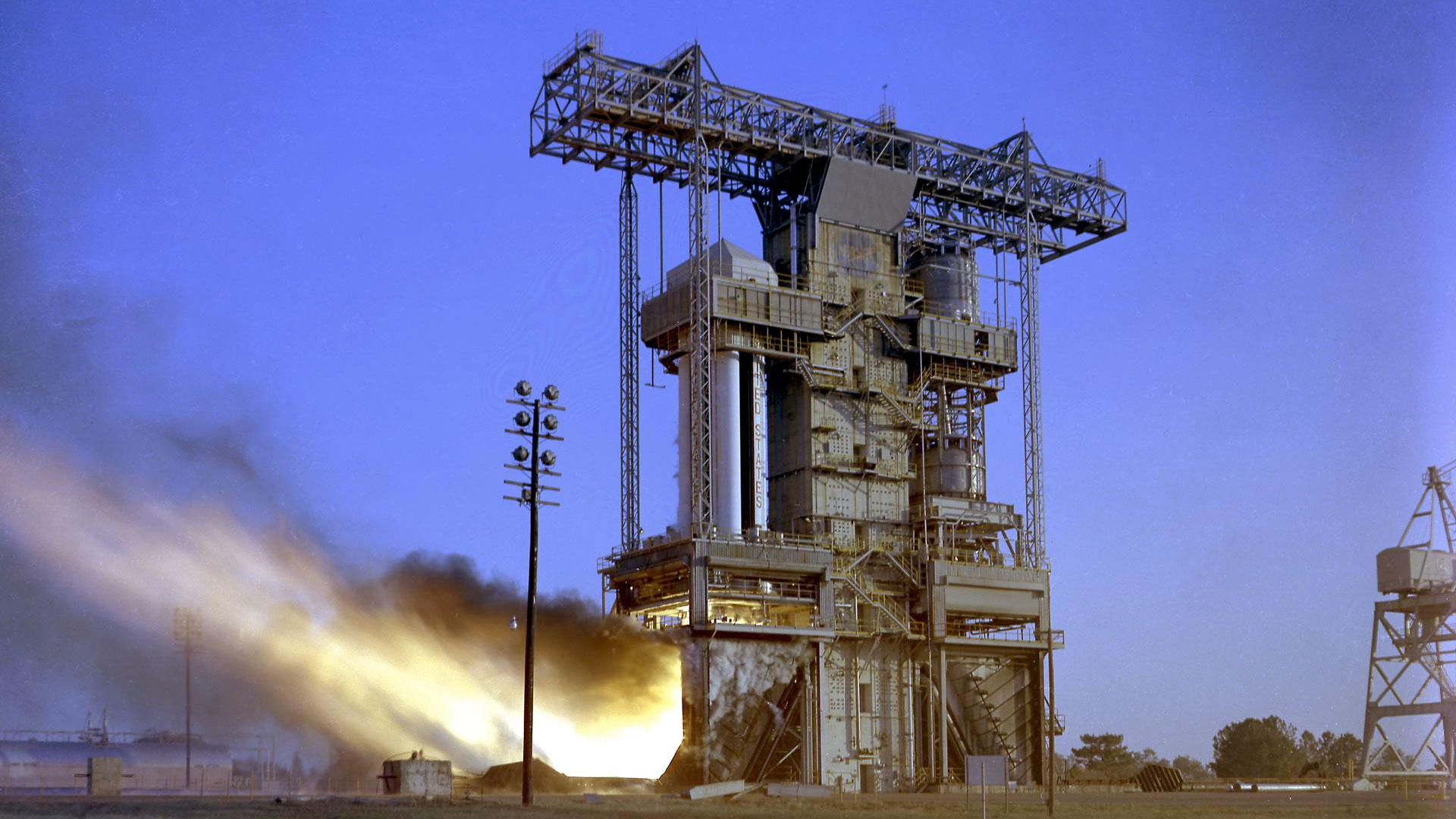
A Saturn I rocket’s first stage (S-1-10) is test fired at the Propulsion and Structural Test Facility, or “T-tower,” at NASA’s Marshall Space Flight Center in Huntsville, Alabama, in 1964.
Credit: NASA
A Saturn I rocket’s first stage (S-1-10) is test fired at the Propulsion and Structural Test Facility, or “T-tower,” at NASA’s Marshall Space Flight Center in Huntsville, Alabama, in 1964. Credit: NASA
“While it is hard to let them go, they’ve earned their retirement,” said Rae Ann Meyer, the acting director of the Marshall Space Flight Center. “Each one of these structures helped NASA make history.”
The Dynamic Test Stand (Building 4550) rises more than twice as high as the Propulsion and Structural Test Facility and for good reason—it was built to fit a fully assembled Saturn V (363 feet or 111 meters tall) for mechanical and vibrational trials. Described once as the tallest building in the state, the stand later was used to form the first complete space shuttle stack with a winged orbiter (the prototype “Enterprise”), external fuel tank, and solid rocket boosters.
The Dynamic Test Stand is so tall that, according to NASA, its last use in the early 2000s was as a drop tower in support of microgravity testing. It was added to the National Register of Historic Places and deemed a National Landmark in 1985.
“These structures are not safe,” said Meyer. “Strategic demolition is a necessary step in shaping the future of NASA’s mission to explore, innovate and inspire. By removing these structures that we have not used in decades, we are saving money on upkeep of facilities we can’t use. We also are making these areas safe to use for future NASA exploration endeavors and investments.”

The Dynamic Test Stand at NASA’s Marshall Space Flight Center in Alabama supported the testing of the first fully assembled Saturn V rocket in 1966 and the first stacked space shuttle in 1978.
Credit: NASA
The Dynamic Test Stand at NASA’s Marshall Space Flight Center in Alabama supported the testing of the first fully assembled Saturn V rocket in 1966 and the first stacked space shuttle in 1978. Credit: NASA
Sites and citations
The Propulsion and Structural Test Facility and Dynamic Test Facility were among 19 sites identified for removal at the Marshall Space Flight Center. The count also includes the Neutral Buoyancy Simulator (NBS), a facility that enabled NASA astronauts and researchers to practice for spacewalks and work in microgravity. It comprised a tank that was 75 feet in diameter, 40 feet deep, and designed to hold up to nearly 1.5 million gallons of water (23 by 12 meters by 5.7 million liters).





 English (US) ·