.png)
 12 hours ago
6
12 hours ago
6
What a difference a couple of years makes. When we reviewed the first Wi-Fi 7 routers in late 2023, devices were priced at $600 and higher. To help soften the blow of the sticker shock, many router makers, like Eero and Netgear, introduced the new wireless standard with premium mesh systems that boasted impressive performance and price tags that approached $2,000 for three-node systems.
However, prices have dropped dramatically on the best Wi-Fi routers since then, and you can secure a tri-band Wi-Fi 7 router for around $150 or a dual-band for just under $100. Cudy is going even cheaper with its WR3600E, which has an MSRP of $79.99 and a street price of under $70. That would be an incredible price, if it had the performance and features to match its slightly more expensive dual-band Wi-Fi 7 and Wi-Fi 6 peers. As you read on, you’ll see that the WR3600E perhaps sacrifices a bit too much to reach its bargain basement cost.
Design of the Cudy WR3600E Wi-Fi 7 Router
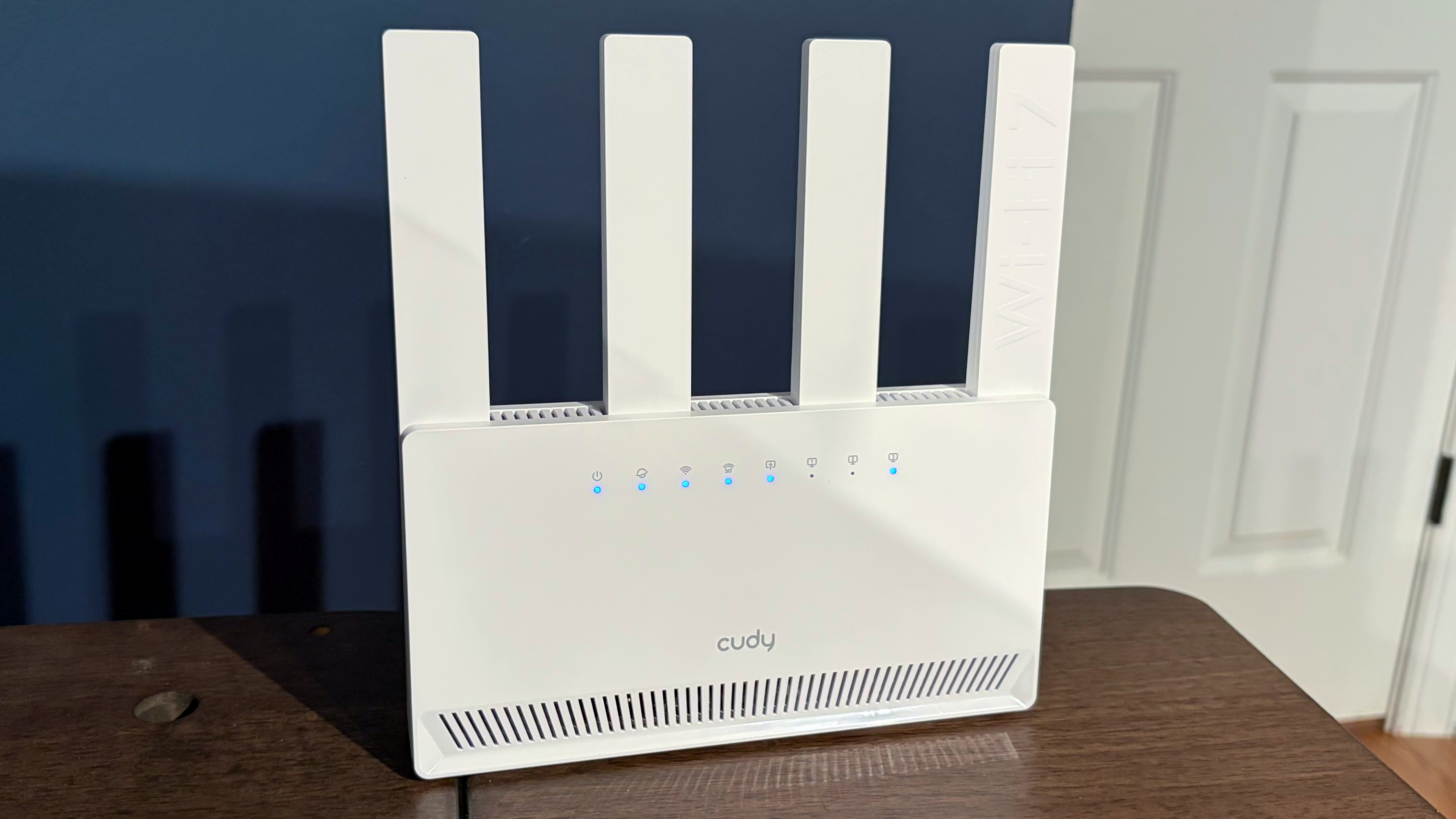
The WR3600E is a surprisingly compact Wi-Fi 7 router. I was surprised at its weight and profile as soon as I lifted it from the attractive retail box. The WR3600E sits vertically and has a broad base to ensure that it doesn’t tip over. But the router's main body is incredibly thin, as are the four antennas mounted at the top. Unlike the antennas on TP-Link Archer BE3600, the ones on the WR3600E are fixed, so keep that in mind if you like to fine-tune transmission and reception. “Wi-Fi 7” is printed on the rightmost antenna.
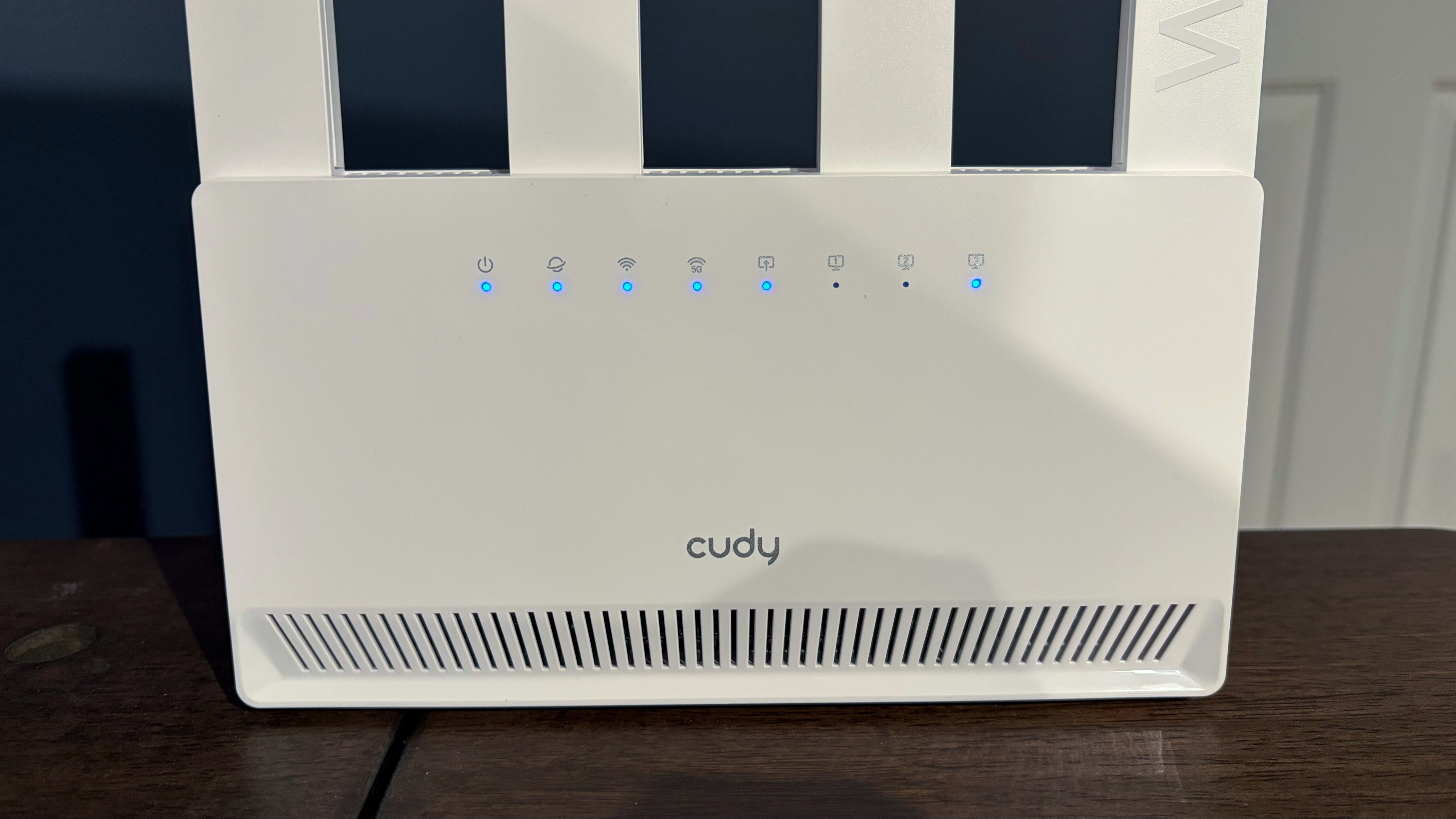
The front of the router has a line of ventilation vents at the bottom, with Cudy branding centered just above. You'll find a row of LEDs near the top of the router, giving the current status for functions like power, 2.4 GHz wireless, 5 GHz wireless, and the three network ports. There are more ventilation vents at the very top of the router between the four antennas.
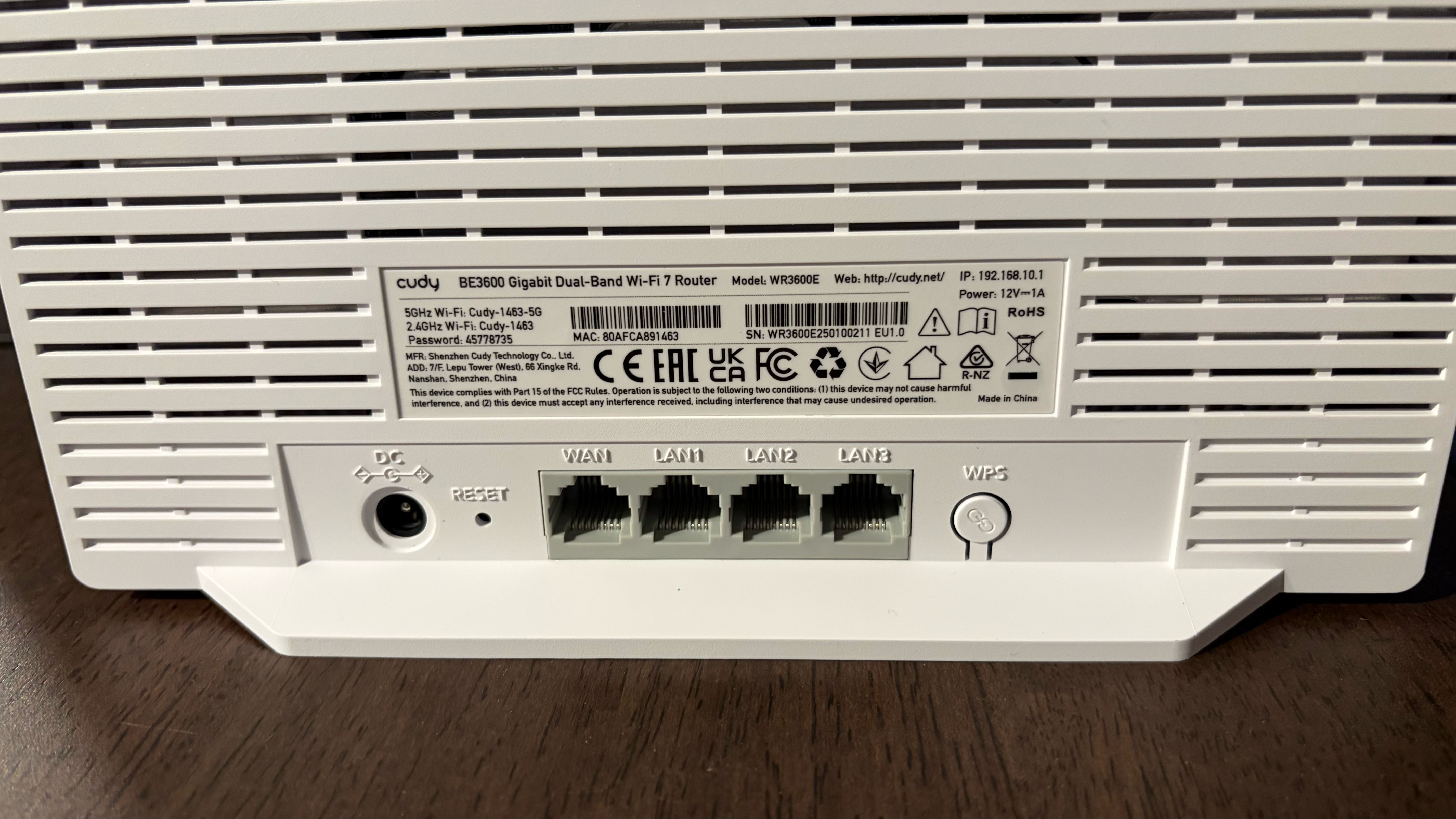
Moving to the back of the router, the WR3600E is surprisingly bare. There's a single gigabit WAN port and three gigabit LAN ports. The GbE WAN is something we typically see in older Wi-Fi 6 routers, whereas most modern Wi-Fi 7 routers (even dual-band models) have at least a 2.5 GbE WAN port. The only other items of note on the back are a pinhole reset button and a WPS button for quickly connecting supported networking gear, such as wireless printers and IoT devices.
Given its price point, Cudy wasn't inclined to include a USB 3.0 port, which is found on slightly more expensive standalone dual-band Wi-Fi 7 routers and would allow you to connect external devices and storage.
Cudy WR3600 Wi-Fi 7 Router Specifications
Swipe to scroll horizontally
MSRP | Wi-Fi Standard | # of Bands | 2.4 GHz Speeds | 5 GHz Speeds | Coverage | Ports | |
$79.99 | Wi-Fi 7 | 2 | 688 Mbps | 2,882 Mbps | 1,400 sq ft | 1 x 1G WAN, 3 x 1G LAN | |
$219.99 | Wi-Fi 7 | 2 | 688 Mbps | 5,764 Mbps | 2,600 sq ft | 1 x 2.5G WAN, 1x 2.5G LAN, 3 x 1G LAN, 1x USB 3.0 | |
$99.99 | Wi-Fi 7 | 2 | 688 Mbps | 5,764 Mbps | 3,000 sq ft | 1 x 2.5G WAN, 1x 2.5G LAN, 3 x 1G LAN, 1x USB 3.0, 1x USB 3.2, 1x USB 3.0 | |
$249.99 | Wi-Fi 7 | 2 | 1,032 Mbps | 5,764 Mbps | 2,750 sq ft | 1 x 10G WAN/LAN, 1x 2.5G WAN/LAN, 3x 2.5G LAN |
Setting up the Cudy WR3600E Wi-Fi 7 Router
You can manage the Cudy WR3600E using the Cudy app or via a traditional web browser. I opted for the latter method, which was very simple and quick to complete. I kicked off the setup process for the WR3600E by selecting its SSID and entering the password printed on the back of the unit. I was then tasked with choosing to put the device in router or access mode.
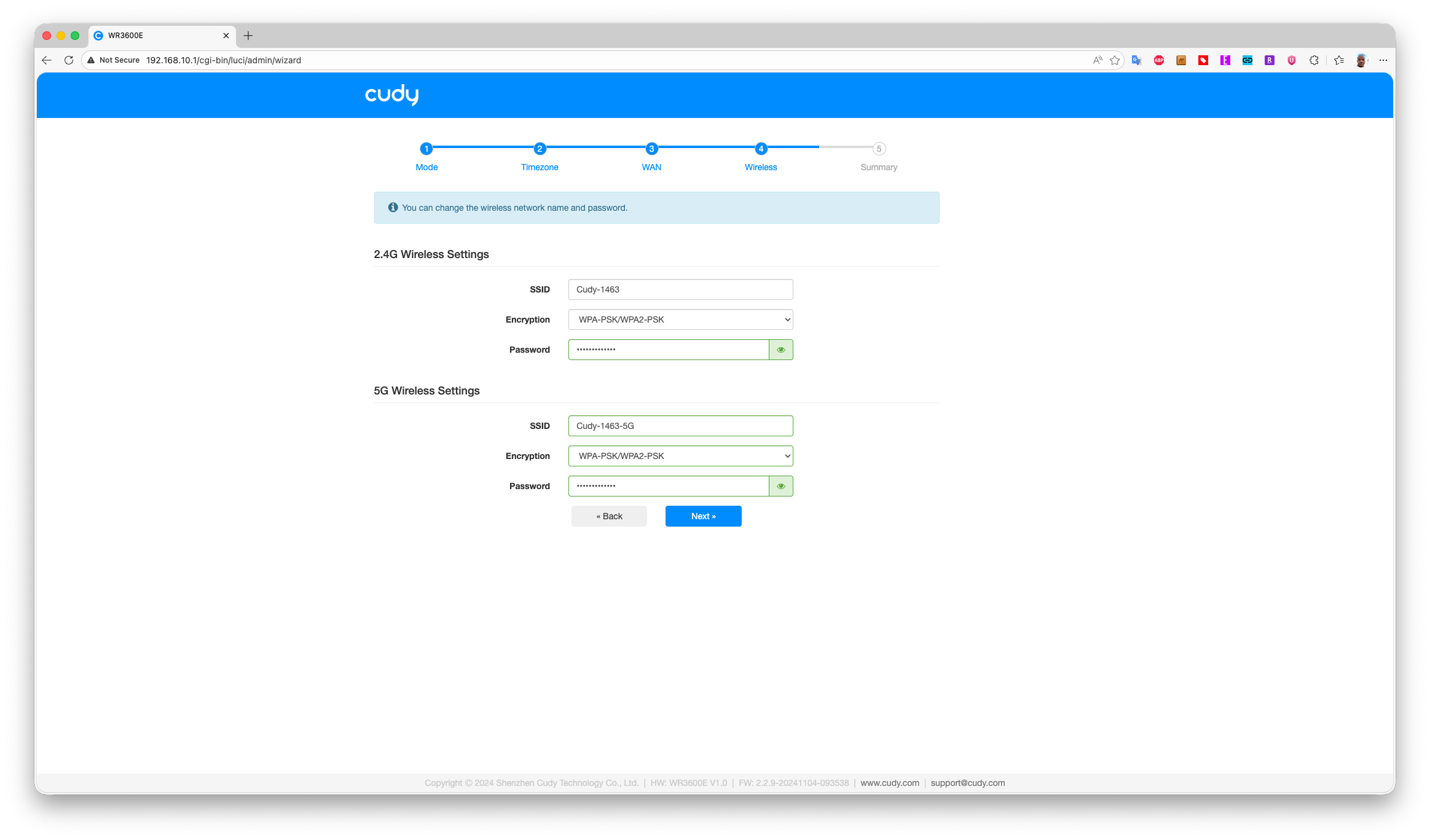
Step 2 was to choose my time zone (which was already correctly entered) and select whether I wanted the router to auto-update (I chose yes). Step 3 automatically configured my WAN connection type, while Step 4 allowed me to choose custom SSIDs and passwords for the 2.4 GHz and 5 GHz bands. After completing Step 4, a summary page displayed the options I had selected, and the router rebooted to apply them. The whole process took about two minutes, from initial setup to the router rebooting and being fully operational.
Cudy WR3600E Wi-Fi 7 Router Software
I initially interacted with the WR3600E using just a web browser. I found the GUI to be unremarkable and quite spartan. The router's homepage is System Status (the first tab in the navigation menu at the top), which provides download/upload rates at the top and various vitals below. You'll find internet connection status, information on the 2.4 GHz and 5 GHz networks, router firmware information, and more. The next tab is Quick Setup, which goes through the same configuration steps as when you first set up the router.
The General Settings tab allows you to configure your WAN mode, wireless settings (including the ability to enable Smart Connect, which combines the 2.4 GHz and 5 GHz bands into a single SSID), enable VPN, set up a captive portal, and upgrade the router's firmware.
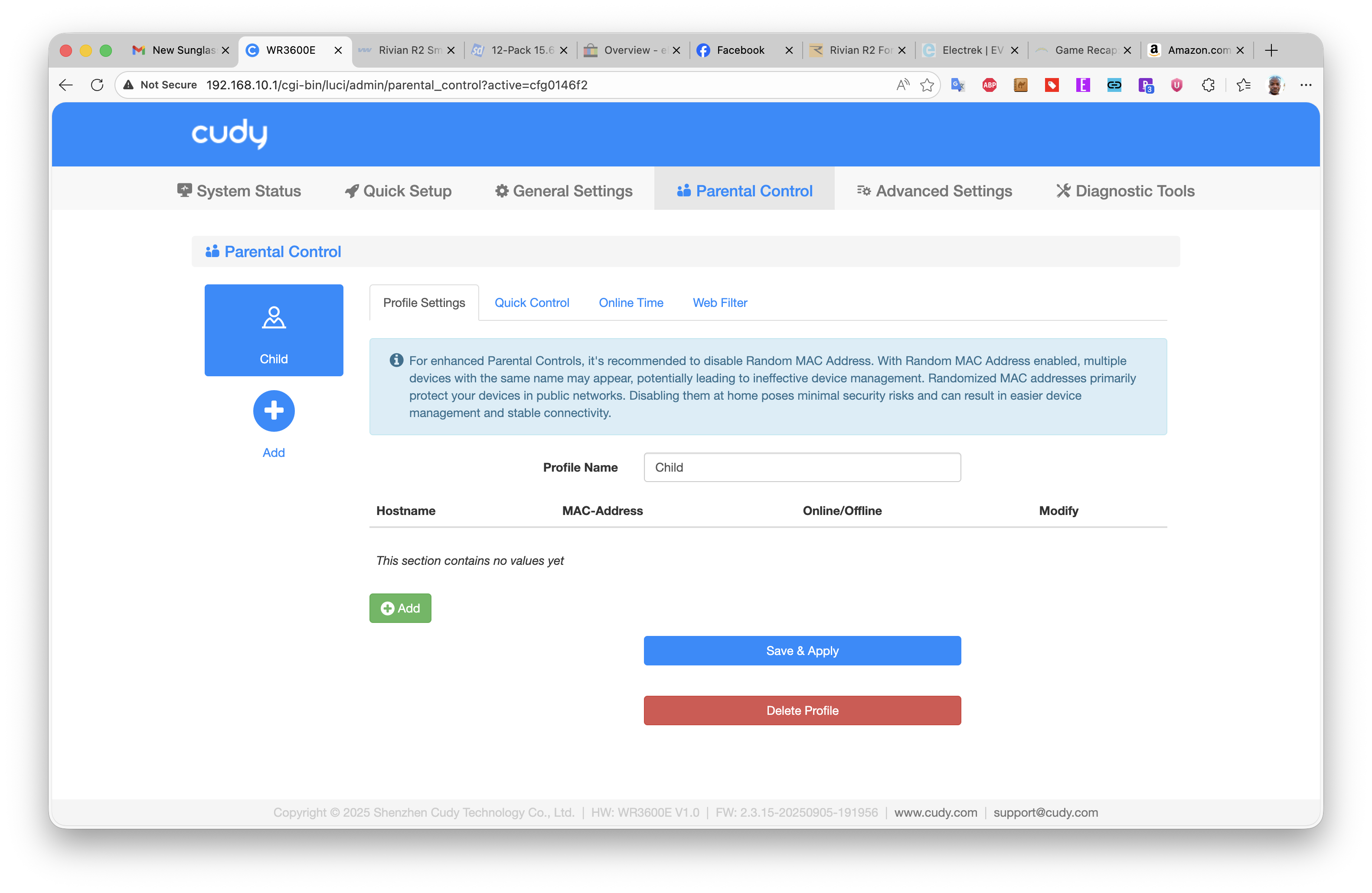
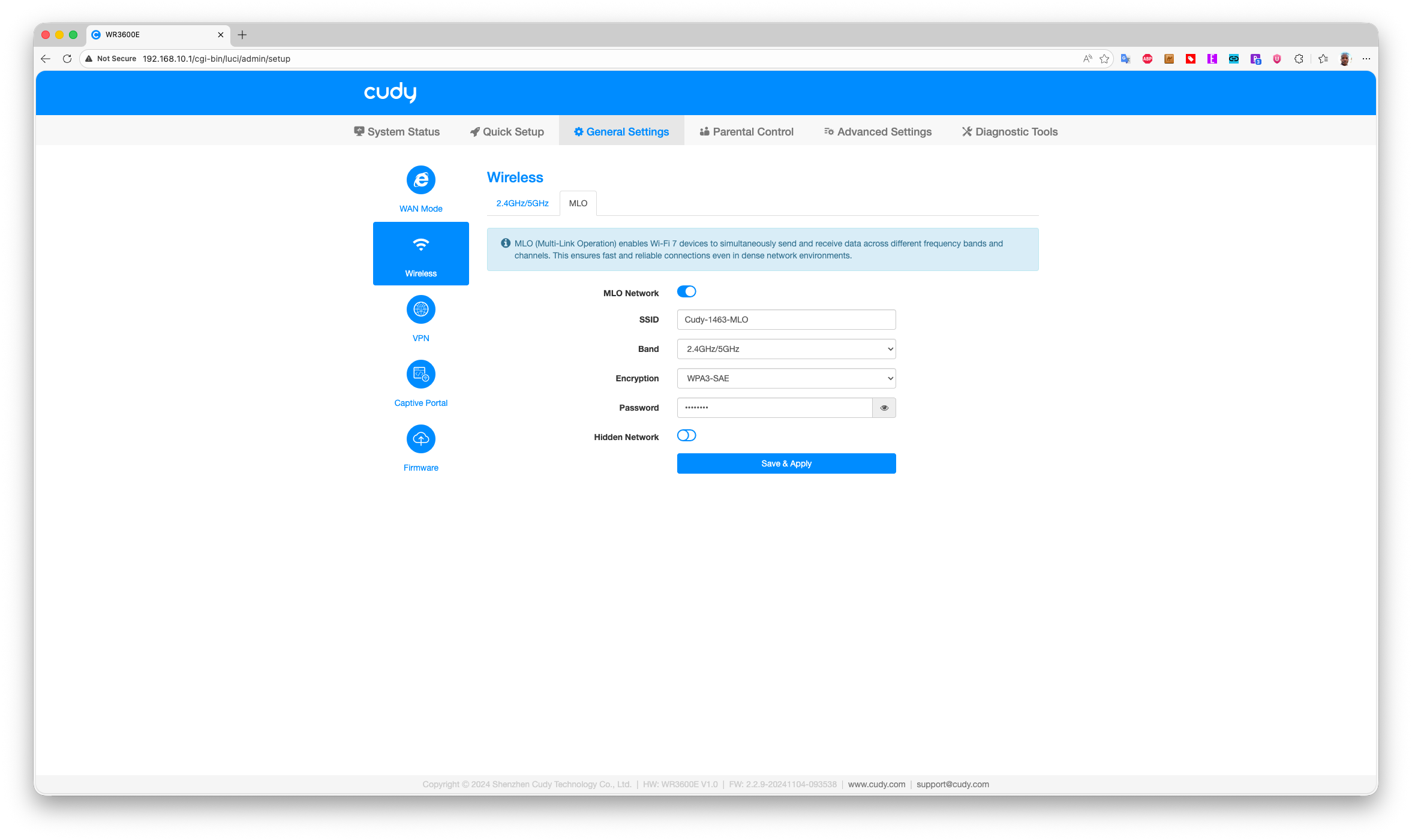
The Parental Controls tab offers comprehensive controls for curating content, and you can create individual profiles for multiple children. Once you've added your child's device, you can pause the internet for 5 minutes to 120 minutes. You can also assign each device a specific "window" of time to use during the day. There's also a web filter that lets you blacklist or whitelist specific sites.
There is an Advanced Settings tab, which I found overwhelming, as the page is littered with dozens of blue circles of the same size. Each leads to a specific setting for the router, but I wish that Cudy used a more mainstream menu system rather than a smartphone home screen-style layout.
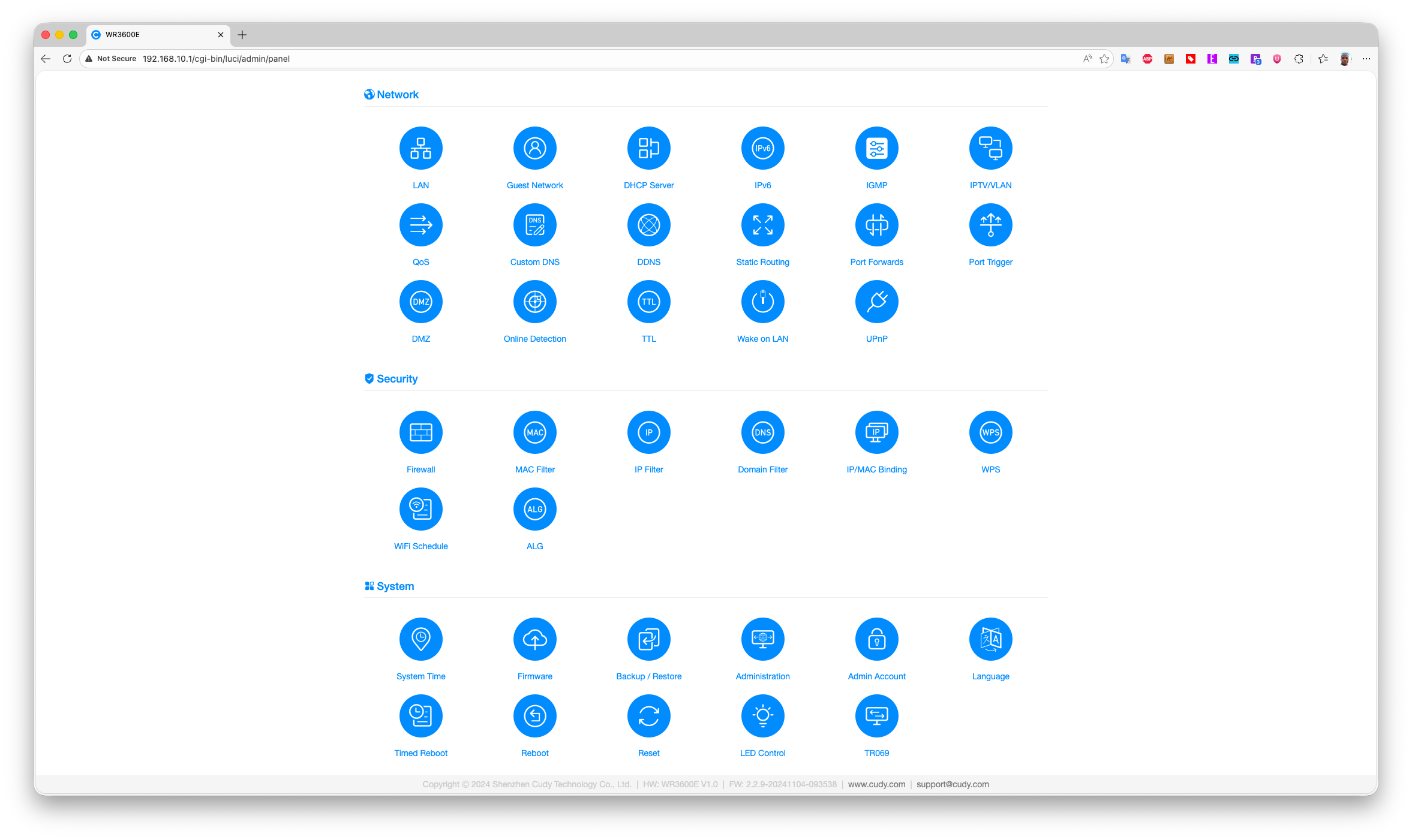
Clicking each circle opens a pop-up window that lets you change the associated setting. On the plus side, there's a plethora of settings to adjust, including guest network, QoS, port forwarding, MAC filtering, Wi-Fi schedule, settings backup/restore, and LED control (for the front panel).
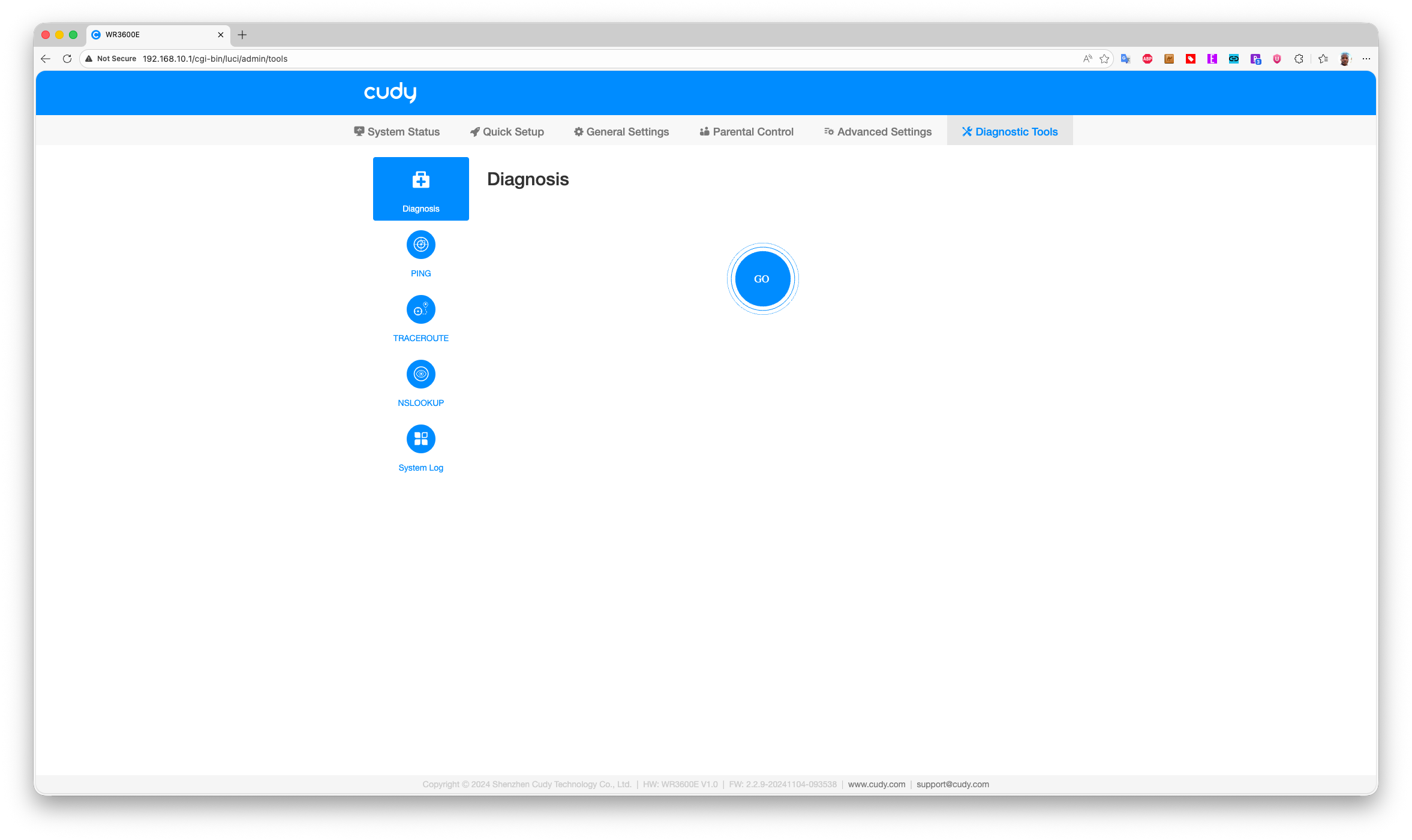
The final tab is Diagnostic Tools, which provides helpful network tools such as ping, traceroute, nslookup, and a system log.
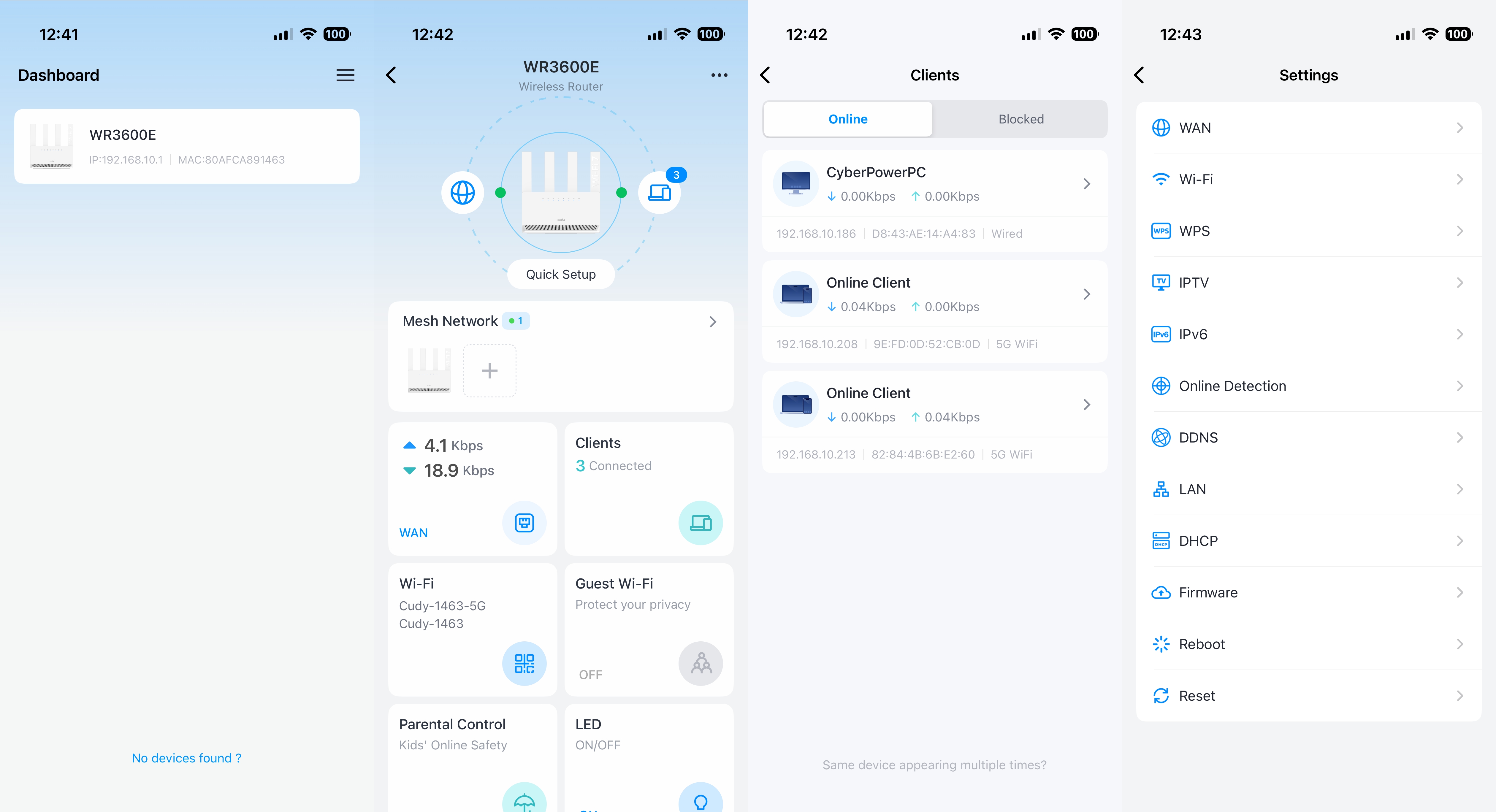
The Cudy app was easier to use with large tiles on the home page and a proper menu system for navigating advanced settings. Once I installed the app on my smartphone, I opted to use it for all subsequent interactions with the WR3600E. It even supports remote management when you're not on your home network after creating a Cudy cloud account.
Cudy WR3600E Wi-Fi 7 Router Performance
We tested the WR3600E using our venerable Wi-Fi client testing rig, consisting of an MSI Pro B650M-A Wi-Fi motherboard, AMD Ryzen 5 7600 processor, 32GB of DDR5 memory, a 1TB PCIe 4.0 SSD, an MSI Herald-BE Wi-Fi 7 adapter (Qualcomm NCM865), and Windows 11 Home. As always, our server used for testing was a Windows 11 Home machine with a 10 GbE network card connected to one of the GbE ports on the WR3600E router.
We should caution that when it comes to wireless testing, your mileage may vary. The results that I obtained in my home environment may not mirror those that you see in your apartment, home, or office setting. Home construction, wall thickness, the choice of materials in the flooring, and even the number of walls between the router and clients can affect performance. However, the numbers presented should give you a general ballpark estimate as to how the WR3600E should perform and are comparable to our previous tests, as our testing locations and methodology don’t change.
With that said, our iPerf3 throughput tests are conducted at six-foot and 25-foot distances, with and without network traffic. In the congested traffic tests, we add six wireless clients streaming 4K YouTube videos across multiple wireless bands.
Generally speaking, the WR3600E performed poorly compared to contemporary dual-band Wi-Fi 7 routers that we’ve tested. The WR3600E has two things working against it: transmission power and maximum throughput. The lower transmission results in the WR3600E covering just 1,400 square feet, roughly half the area of the other assembled competitors. The maximum throughput on the 5 GHz channel is also half that of its competitors (2,882 Mbps versus 5,764 Mbps). Keep both of these shortfalls in mind when looking at the throughput results.
In our 5 GHz iPerf3 throughput test, the WR3600E pulled up the rear at short range (six feet), with 716 Mbps. However, the WR3600E managed to slip into second place (564 Mbps) at long range (25 feet), putting it behind only the Asus RT-BE86U(806 Mbps).
Switching over to the 2.4 GHz band, the RG-E6 came in last place at short range (82 Mbps), putting it behind the Archer BE400 (135 Mbps) and the Archer BE3600 (214 Mbps). At long range, however, the best the WR3600E could muster was 44 Mbps.
The rankings were similar with congested traffic; the WR3600E landed in last place at short range (716 Mbps) on the 5 GHz band. However, it managed to take first place at long range with a throughput of 540 Mbps. 2.4 GHz band congesting testing saw the WR3600E manage a last-place showing (63 Mbps) compared to the overachieving Archer BE3600 (205 Mbps) at short range. With distance testing stretched out to 25 feet, the WR3600E managed third place with 38 Mbps (although the rankings were relatively tight here).
Bottom Line
Cudy is targeting the very bottom of the Wi-Fi 7 market with the WR3600E, as you can tell from its MSRP of just $79.99. However, the street price is even lower, with an instant coupon on Amazon right now taking it to just $66.39. That’s a remarkably low price for a dual-band router, but it comes with a couple of caveats.
You only get a GbE WAN and just three GbE LAN ports, while most of the competition give you one 2.5 GbE WAN and four GbE LAN ports. There’s also no USB 3.0 port for connecting external storage to your network. In addition, transmission power is not the WR3600E’s strong point, as evidenced by its small coverage area and generally weak performance compared to the competition. On the plus side, you do get relatively comprehensive configuration options for the router and a smartphone app that supports remote management (when using a Cudy cloud account).
However, the TP-Link Archer BE3600 offers a better bang for your Wi-Fi 7 buck. You'll get 2.5 GbE WAN and an extra GbE port. It also provides a USB 3.0 port and faster overall performance, especially on the 2.4 GHz band. In addition, the price difference between the two isn't significant, as the BE3600 can be had for $81. We consider the extra $15 money well spent.







 English (US) ·